DISCLAIMER: GoldInvestors.news is not a registered investment, legal or tax advisor or broker/dealer. All investment/financial opinions expressed by GoldInvestors.news are from the personal research and experience of the owner of the site and are intended as educational material. Although best efforts are made to ensure that all information is accurate and up to date, occasionally unintended errors and misprints may occur.
Brent crude and West Texas Intermediate both surrendered ground on Monday, sliding roughly three to five percent as traders digested Donald Trump’s 15 percent tariffs and signals that the Iran conflict risk premium may be fading.
The price action signals a market in flux, recalibrating value as policy measures collide with geopolitics and the evolving demand outlook for a fragile global economy.
Here's What They're Not Telling You About Your Retirement
Analysts say the tariff news redefines demand expectations while the easing of geopolitical tensions removes a core supply risk, pressuring crude prices lower in the near term.
At the same time, investors weigh longer term implications for growth, investment in energy projects, and the supply response from OPEC plus non-OPEC producers.
Currency dynamics also matter, since a stronger dollar tends to suppress commodity prices denominated in greenbacks even as inflation fears mount in other parts of the economy.
With tariffs potentially sparking price pressures elsewhere, investors worry about central bank policy responses that could in turn amplify volatility in energy markets.
This Could Be the Most Important Video Gun Owners Watch All Year
Shale producers are the wildcard in the near term, offsetting OPEC’s careful output strategy as U.S. output continues to rise.
Domestic drilling activity has kept inventories lean and export channels open, allowing prices to soften without triggering a sudden supply crunch.
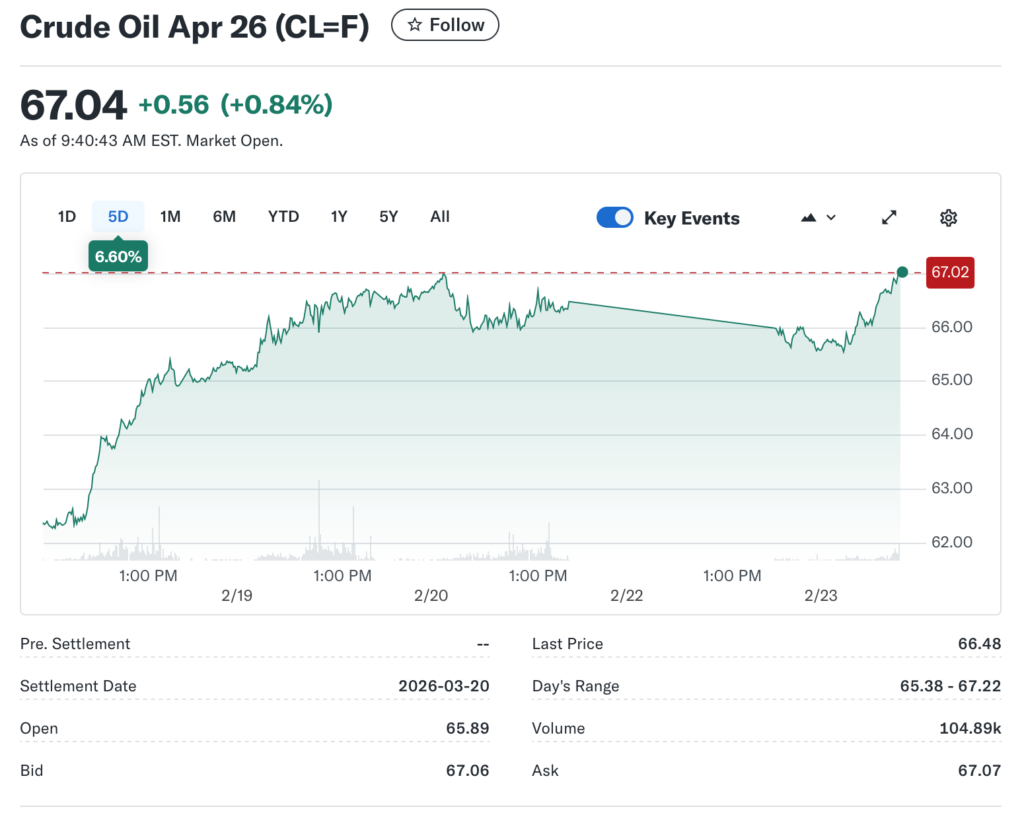
Price action now reflects a bifurcated incentive structure for oil markets, balancing immediate policy moves with stubbornly slow demand growth in parts of the world. The net result is a choppy trading range that tests risk-on appetite and the discipline of risk management across portfolios.
Geopolitical risk remains a factor, but the easing of Iran tensions reduces the near term premium that had supported prices earlier this year. Traders will monitor any escalation or new sanctions announcements that could tilt sentiment back toward risk-off assets.
From an investment perspective, traders are leaning toward diversification and hedges as a bulwark against policy surprises.
Energy equities remain sensitive to crude trajectories, with large swings driven by the tug-of-war between supply discipline and demand resilience.
Historically tariffs have been a double edged sword for energy markets, injecting uncertainty and often slowing capital expenditure in the sector. The current episode underscores that energy prices do not move in isolation from broader policy shifts, even when the motive is to rebalance trade relations.
Gasoline and diesel prices at the pump will reflect crude moves with a lag, filtered through refinery margins and inventory levels.
Consumers may feel some pressure if tariff regimes persist, but the immediate price signal remains heavily dependent on supply chain resilience and seasonal demand patterns.
From a policy standpoint, the tariff strategy injects a new variable into the inflation equation that central banks must acknowledge without overreacting to short lived price spikes.
Markets will adjust as fiscal plans interact with global demand signals and the pace of monetary tightening abroad.
What to watch next is the pace and durability of Iran diplomacy and whether tariffs endure longer than brief spells.
A rapid de-escalation could rekindle risk appetite and push oil higher, while a drawn out tariff regime might depress prices further as buyers seek alternative energy sources and hedges.
The oil complex remains a barometer of policy and geopolitics, priced at the intersection of protectionist measures and the mitigation of regional risk.
For investors, a disciplined approach that prioritizes risk management, liquidity, and a long horizon remains the prudent path through this volatile chapter.
DISCLAIMER: GoldInvestors.news is not a registered investment, legal or tax advisor or broker/dealer. All investment/financial opinions expressed by GoldInvestors.news are from the personal research and experience of the owner of the site and are intended as educational material. Although best efforts are made to ensure that all information is accurate and up to date, occasionally unintended errors and misprints may occur.
Join the Discussion
COMMENTS POLICY: We have no tolerance for messages of violence, racism, vulgarity, obscenity or other such discourteous behavior. Thank you for contributing to a respectful and useful online dialogue.