DISCLAIMER: GoldInvestors.news is not a registered investment, legal or tax advisor or broker/dealer. All investment/financial opinions expressed by GoldInvestors.news are from the personal research and experience of the owner of the site and are intended as educational material. Although best efforts are made to ensure that all information is accurate and up to date, occasionally unintended errors and misprints may occur.
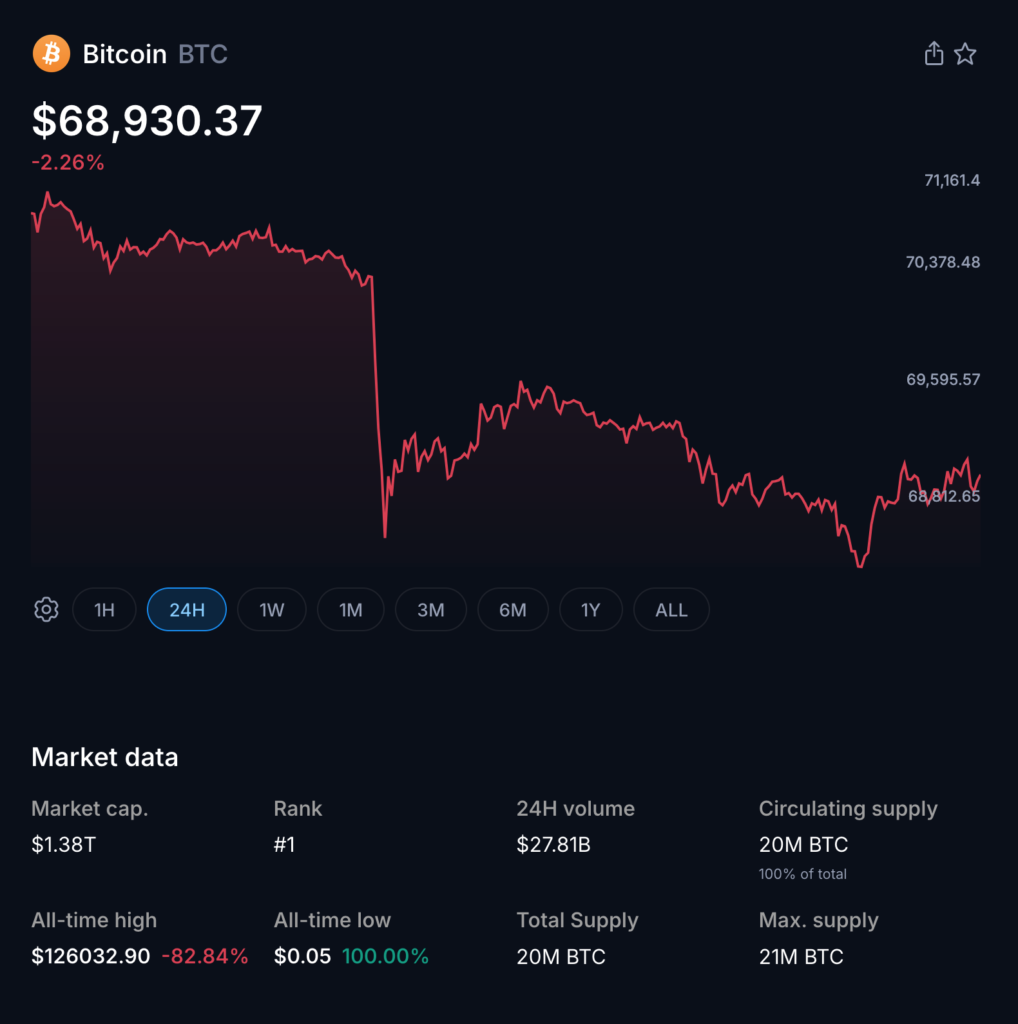
Bitcoin edged lower to the $68,000 region as traders priced in a hawkish tilt from the Federal Reserve and a tense global backdrop that includes geopolitical risks, stubborn inflation, and thinning liquidity.
The move highlights how policy expectations, geopolitics and fund flows are converging to test risk appetite across equities, commodities and digital assets, forcing investors to rethink hedges, liquidity reserves and timing.
Officials have signaled that rates may remain higher for longer, and that stance has boosted the dollar while dampening appetite for risk assets across stocks, bonds and alternative markets.
The immediate pressure comes as ETF outflows complicate demand for cryptocurrency exposure, with persistent selling in listed products and cautious buyers waiting for clearer policy signals.
Here's What They're Not Telling You About Your Retirement
ETF outflows compress the buying power behind Bitcoin through exchange traded products, with investors reallocating to cash or shorter duration assets while hedge funds recalibrate risk budgets.
That dynamic compounds selling pressure when prices are already sensitive to macro headlines and when liquidity pockets tighten during periods of heightened uncertainty.
Geopolitical tensions in the Middle East have sharpened risk aversion across thin liquidity windows, amplifying the impact of every headline on traders trying to gauge fair value.
This Could Be the Most Important Video Gun Owners Watch All Year
Traders seek shelter in traditional safe havens, which often means gold and government bonds, rather than speculative assets, and that preference can widen divergences between crypto and conventional markets.
From a macro perspective the combination of higher for longer policy and geopolitical risk is shaping a rare clash for crypto markets that tests assumptions about scarcity and hedging effectiveness.
Inflation readings and the pace of policy normalization feed into forward rate curves and market expectations, creating a moving target for investors attempting to price risk into valuations.
Technically Bitcoin has seen several waves of volatility since touching record peaks, and the $68,000 level now sits near a psychological boundary that traders watch closely for cues about momentum.
While some indicators show occasional stabilization, the path remains uncertain as new headlines and macro data shift sentiment and potential buyers struggle to establish a durable bid.
Historically, periods of policy tightening coincide with drawdowns in speculative assets as investors rebalance portfolios, assessing whether valuations have overshot or simply reflect overstretched risk appetite.
The current phase mirrors that pattern but with the added complexity of evolving ETF structures and shifting institutional interest, which makes every price move more consequential for low liquidity markets.
On the policy side the Fed has stressed data dependence and resilience to higher rates, signaling a cautious but persistent path rather than an abrupt pivot.
That stance keeps funding costs elevated and reinforces the dollar's bid, which in turn pressures Bitcoin priced in greenbacks and complicates relative value comparisons with hard assets.
ETF dynamics are central to incentive structures for crypto exposure, and the flavor of flows can set the tone for risk appetite across the entire sector. If inflows lag and redemptions accelerate, market makers and arbitrage desks adjust, widening price swings in shorter windows and increasing the likelihood of sharp correlations with traditional markets.
Institutional participation remains a mix of cautious hedging and selective long exposure as managers weigh the costs of nonperforming capital and the prospects for normalization. Some funds still build positions on declines, but a broader appetite for risk assets has not returned with vigor, keeping bitcoin and related assets on a tighter leash.
Looking ahead, a stabilizing path would likely require a cooler macro backdrop or a clear trajectory toward policy normalization that reduces uncertainty and invites renewed capital commitments.
Improvements in regional stability and a halt to persistent selling in ETFs could help steady bids, while improved liquidity conditions would encourage more disciplined entry and exit flow.
Ultimately the current price action illustrates how macro policy and global risk are intertwined with crypto markets, forcing investors to test assumptions about risk, return and time horizons.
Investors who manage risk, diversify and remain disciplined may navigate the volatility more effectively, extracting value during episodes of tension and potential breakthroughs when policy and liquidity align.
DISCLAIMER: GoldInvestors.news is not a registered investment, legal or tax advisor or broker/dealer. All investment/financial opinions expressed by GoldInvestors.news are from the personal research and experience of the owner of the site and are intended as educational material. Although best efforts are made to ensure that all information is accurate and up to date, occasionally unintended errors and misprints may occur.
Join the Discussion
COMMENTS POLICY: We have no tolerance for messages of violence, racism, vulgarity, obscenity or other such discourteous behavior. Thank you for contributing to a respectful and useful online dialogue.