DISCLAIMER: GoldInvestors.news is not a registered investment, legal or tax advisor or broker/dealer. All investment/financial opinions expressed by GoldInvestors.news are from the personal research and experience of the owner of the site and are intended as educational material. Although best efforts are made to ensure that all information is accurate and up to date, occasionally unintended errors and misprints may occur.
Fast moving markets responded with striking urgency on Friday after news that Iran has fully reopened the Strait of Hormuz to all maritime traffic, a development that immediately shifted risk pricing across several asset classes.
The announcement, delivered by Iranian Foreign Minister Seyed Abbas Araghchi in an X post at 8:45 am Eastern, set in motion a rapid repricing process across commodities and equity futures that traders are still parsing.
Gold traders quickly bid up the metal toward the psychological milestone near four thousand nine hundred dollars per ounce, reflecting a broad risk hedge bid as investors reassessed geopolitical risk premia.
Equities and other risk assets also moved on the headline, with futures markets pricing in higher implied volatility while market participants recalibrated expectations for growth, inflation, and policy responses.
Here's What They're Not Telling You About Your Retirement
Oil prices slid sharply on the immediate optimism about open shipping lanes, but the move carried complexity as traders weighed the potential for errant shipments, sanctions risk, and the broader supply picture.
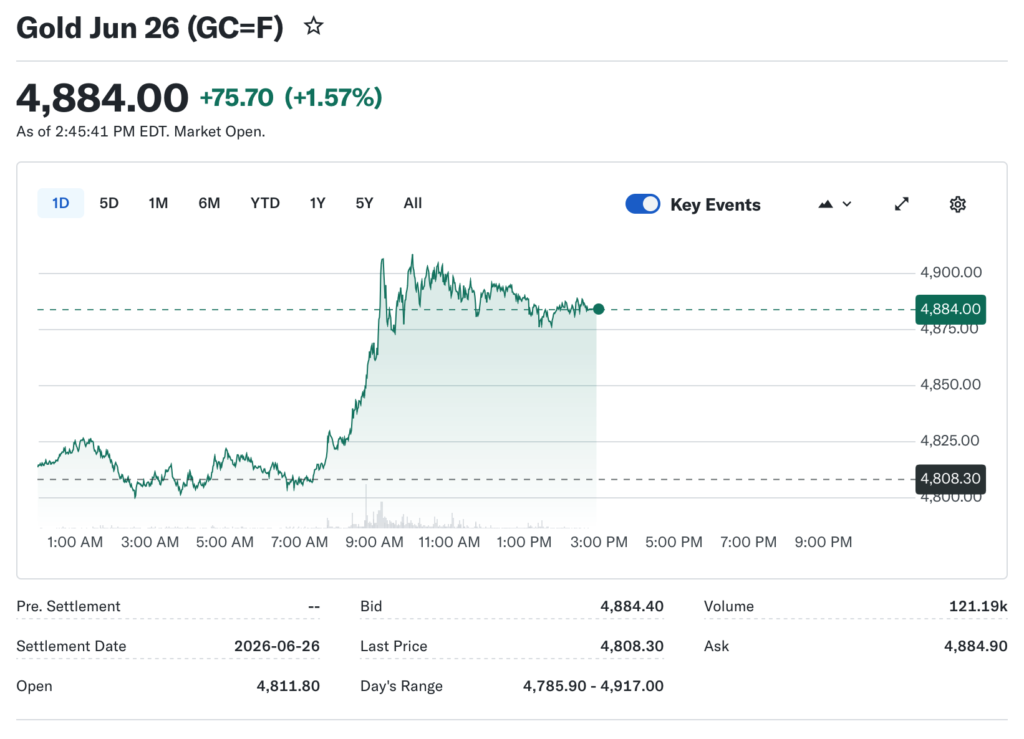
Analysts noted that the initial response could prove temporary, and that longer term price trajectories will depend on how quickly actual flows normalize and how policy makers respond to evolving threats.
From a broader macro perspective the Hormuz reopening injects a fresh layer of complexity into energy markets, exchange rates, and the broader geopolitical risk landscape that feeds into every major asset class.
This Could Be the Most Important Video Gun Owners Watch All Year
It challenges traders to separate geopolitical tail risks from underlying fundamentals while recognizing that sentiment can override near term data, a dynamic that tends to amplify volatility and create uncomfortable whiplash in portfolios.
Traders understand headlines often drive the day to day moves far more than any single indicator, and Friday provided an instructive example of how narratives can trump circumstantial data for a period.
In this environment short term moves are not a substitute for disciplined strategy, and the risk lies in letting headlines guide allocation decisions without due diligence.
Gold’s climb underscores the enduring appeal of safe haven assets when risk signals flash, a factor many investors count on during periods of uncertainty and policy ambiguity.
For portfolio managers this development argues for disciplined diversification and explicit hedging strategies that can weather a sequence of headline driven swings without sacrificing core growth.
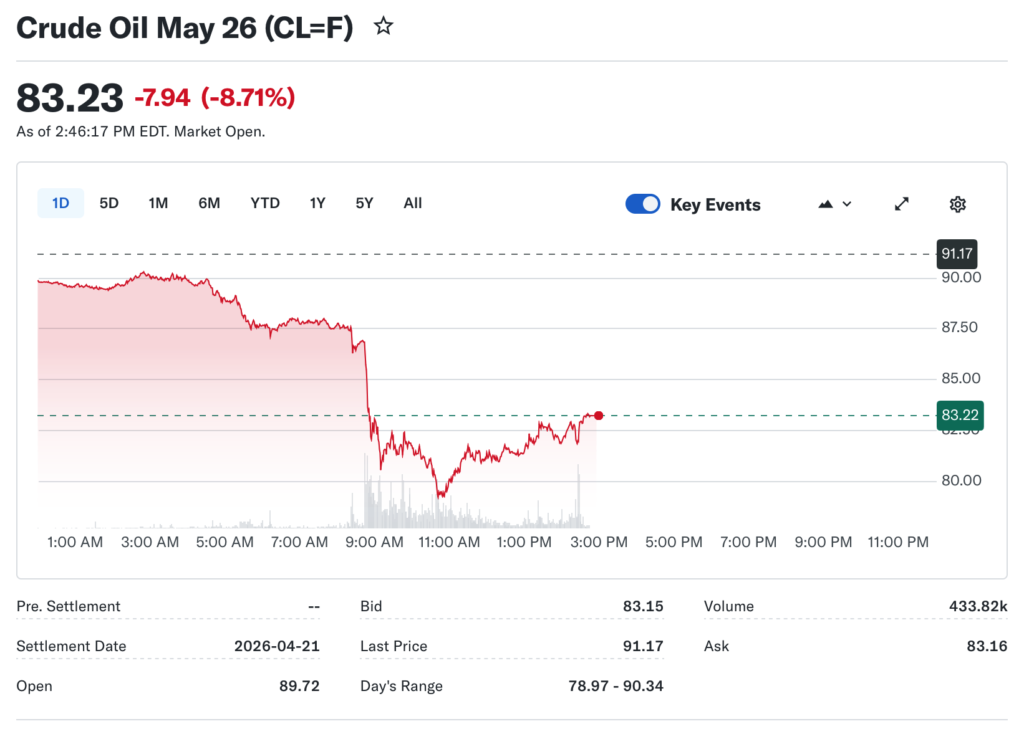
This episode also highlights how quickly sentiment can swing when a single geopolitical milestone moves the narrative, and it reminds investors that the tape does not always reflect fundamentals at the same pace. Investors should keep a list of potential catalysts and respond with measured positioning rather than knee jerk reactions born from fear or frenzy.
Energy markets remain highly sensitive to the politics of shipping routes and sanctions, a reminder that strategic leverage can swing prices in volatile bursts.
The Hormuz development adds a new variable to the supply risk calculus that traders will monitor for weeks to come while policymakers weigh sanctions postures and potential flow constraints.
As Iran signals a willingness to reopen the channel, traders and policymakers will watch for the practical implications for oil flows and global demand signals, testing how quickly supply expectations converge with real world shipments.
In the meantime, gold and other metals may retain bid demand as a buffer against headline risk and the prospect of policy missteps that could stoke volatility.
Allocations that emphasize cash flow, high quality assets and hedges look prudent in this uncertain climate where the aim is to preserve capital while staying connected to opportunity.
Thus investors should favor a disciplined approach and avoid knee jerk reactions to every headline while maintaining a framework that can endure a range of outcomes.
Our analysis suggests that while today's move creates a dramatic one day shift, the real test will come from sustained policy signals and how the Strait of Hormuz is managed in practice.
If tensions persist, gold and other safe havens can stay bid while energy assets remain volatile as traders price in higher insurance costs and potential disruption in shipments.
In the end the market is a reflection of risk pricing rather than any single event, and this episode reinforces the need for vigilance, discipline and a well structured long term plan.
Traders who stay grounded in fundamentals and avoid crowd dynamics are best positioned to navigate the next few weeks and protect capital through a spectrum of outcomes.
DISCLAIMER: GoldInvestors.news is not a registered investment, legal or tax advisor or broker/dealer. All investment/financial opinions expressed by GoldInvestors.news are from the personal research and experience of the owner of the site and are intended as educational material. Although best efforts are made to ensure that all information is accurate and up to date, occasionally unintended errors and misprints may occur.
Join the Discussion
COMMENTS POLICY: We have no tolerance for messages of violence, racism, vulgarity, obscenity or other such discourteous behavior. Thank you for contributing to a respectful and useful online dialogue.