DISCLAIMER: GoldInvestors.news is not a registered investment, legal or tax advisor or broker/dealer. All investment/financial opinions expressed by GoldInvestors.news are from the personal research and experience of the owner of the site and are intended as educational material. Although best efforts are made to ensure that all information is accurate and up to date, occasionally unintended errors and misprints may occur.
Gold and silver may be preparing for another historic breakout as signs of a peace deal between the United States and Iran spark renewed optimism across global markets.
After a turbulent start to 2026 that saw record highs give way to sharp corrections, both metals are once again climbing as traders anticipate an end to the war that has clouded economic visibility for months.
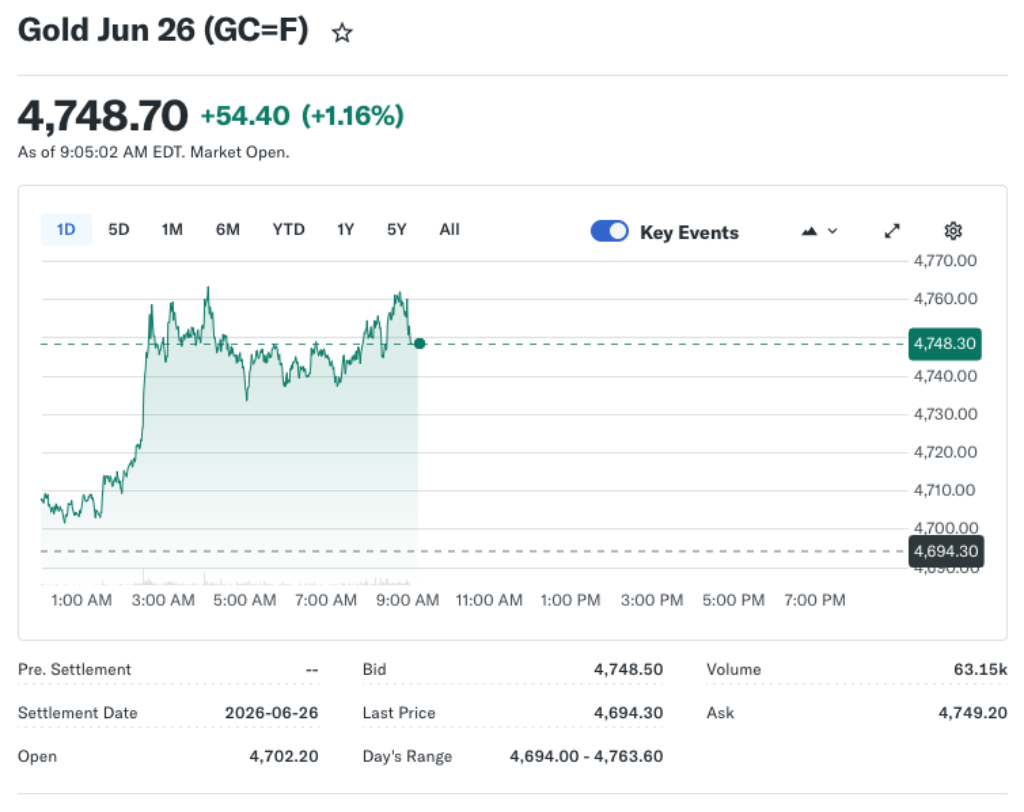
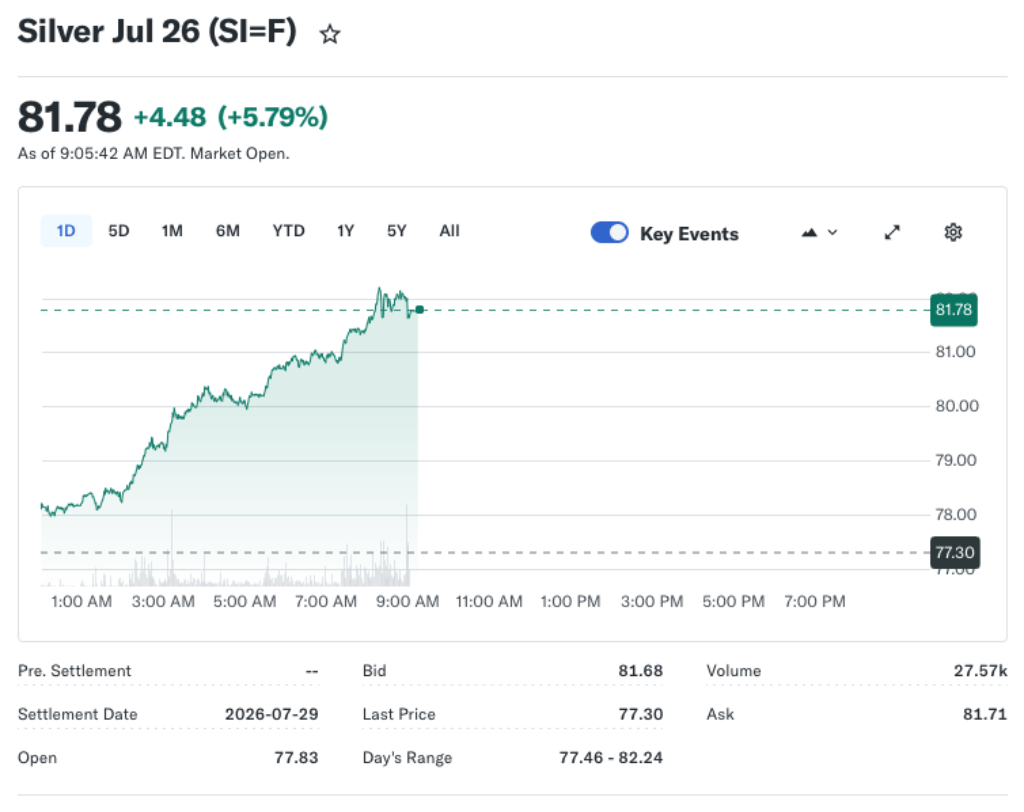
Spot gold rose 1.2 percent to around 4,750 dollars per ounce Thursday morning, while silver surged 3 percent to nearly 80 dollars an ounce.
The gains come on growing belief that Washington and Tehran are close to a deal to halt the 69‑day conflict that has rattled commodities and currencies alike.
Analysts say a resolution could lift the so‑called “fog of war,” releasing pent‑up bullish momentum in precious metals that had been subdued by war‑driven volatility and profit‑taking.
Gold futures in the United States matched spot prices, while silver futures for July jumped nearly 4 percent.
The current rally follows a record‑breaking year in 2025 when gold soared 66 percent and silver more than doubled in value.
Those meteoric runs were interrupted early this year as traders locked in profits and rising oil prices drove expectations for tighter monetary policy. Nevertheless, many market watchers believe the long‑term fundamentals that powered those rallies remain intact.
Ross Norman, CEO of Metals Daily, explained that the decline in early 2026 was largely a correction rather than a reversal.
“The yellow metal entered the conflict significantly overbought,” he said, adding that dealers used the geopolitical chaos as a reason to take profits and reset the market.
He noted that gold’s relationship with the dollar and oil became distorted as both also acted as safe havens, an unusual situation that muddied the usual dynamics.
Francis Tan of Indosuez Wealth Management said gold’s safe‑haven role still proved its worth during the market sell‑off in March. “When equities were tumbling, investors who held gold were able to cushion their losses or even take some profits,” Tan said.
He noted that this defensive function remains vital in an environment of overlapping geopolitical and inflationary risks.
Norman observed that the simultaneous rise of the dollar and gold earlier in the war was a symptom of temporary distortions from energy supply fears. “Now that peace talks are progressing, those pressures are fading. It’s as if the handbrake has been released from gold and silver,” he said.
Philippe Gijsels, chief strategy officer at BNP Paribas Fortis, remains one of the most outspoken bulls in the precious metals space. Gijsels called the pullback a “consolidation phase,” noting that higher interest rate expectations acted like gravity, dragging assets across the board. Yet, he insists the secular bull market remains intact and could see new all‑time highs later this year.
Gijsels believes central banks and institutional investors will keep diversifying away from U.S. government debt into tangible assets like gold. “We live in a world of structurally higher inflation,” he said.
“Real assets are essential for protecting wealth, and precious metals are a key part of that strategy. As the fog of war lifts, investors will return to these markets with renewed conviction.”
His view is echoed by Paul Williams, managing director at Solomon Global, who said that silver’s long‑term fundamentals look exceptionally strong.
“Physical supply remains tight while industrial demand from green energy and AI technologies continues to grow,” Williams said. “These factors reinforce silver’s foundation, even in times of short‑term volatility.”
Silver’s broad industrial use in electronics, solar power, and automotive technologies has given it a dual character—both a precious and industrial metal—making it sensitive to geopolitical and economic trends alike.
Williams suggested that a peace deal would boost silver further by reigniting industrial demand alongside investor confidence.
He added that if negotiations between the U.S. and Iran break down, gold would likely lead an immediate safe‑haven surge, but silver’s tighter market means it could quickly catch up once traders refocus on physical scarcity.
Either way, both metals seem well positioned for a strong year ahead, supported by central bank buying, inflation concerns, and distrust in fiat currencies.
For investors who value independence from the traditional financial system, the appeal of owning physical gold and silver remains as strong as ever. In a world full of economic shocks and government interventions, these metals continue to represent stability, real value, and sovereignty.
DISCLAIMER: GoldInvestors.news is not a registered investment, legal or tax advisor or broker/dealer. All investment/financial opinions expressed by GoldInvestors.news are from the personal research and experience of the owner of the site and are intended as educational material. Although best efforts are made to ensure that all information is accurate and up to date, occasionally unintended errors and misprints may occur.
Join the Discussion
COMMENTS POLICY: We have no tolerance for messages of violence, racism, vulgarity, obscenity or other such discourteous behavior. Thank you for contributing to a respectful and useful online dialogue.