DISCLAIMER: GoldInvestors.news is not a registered investment, legal or tax advisor or broker/dealer. All investment/financial opinions expressed by GoldInvestors.news are from the personal research and experience of the owner of the site and are intended as educational material. Although best efforts are made to ensure that all information is accurate and up to date, occasionally unintended errors and misprints may occur.
The gold market is regaining its shine as investors look toward monetary policy rather than geopolitical chaos as the primary driver of prices.
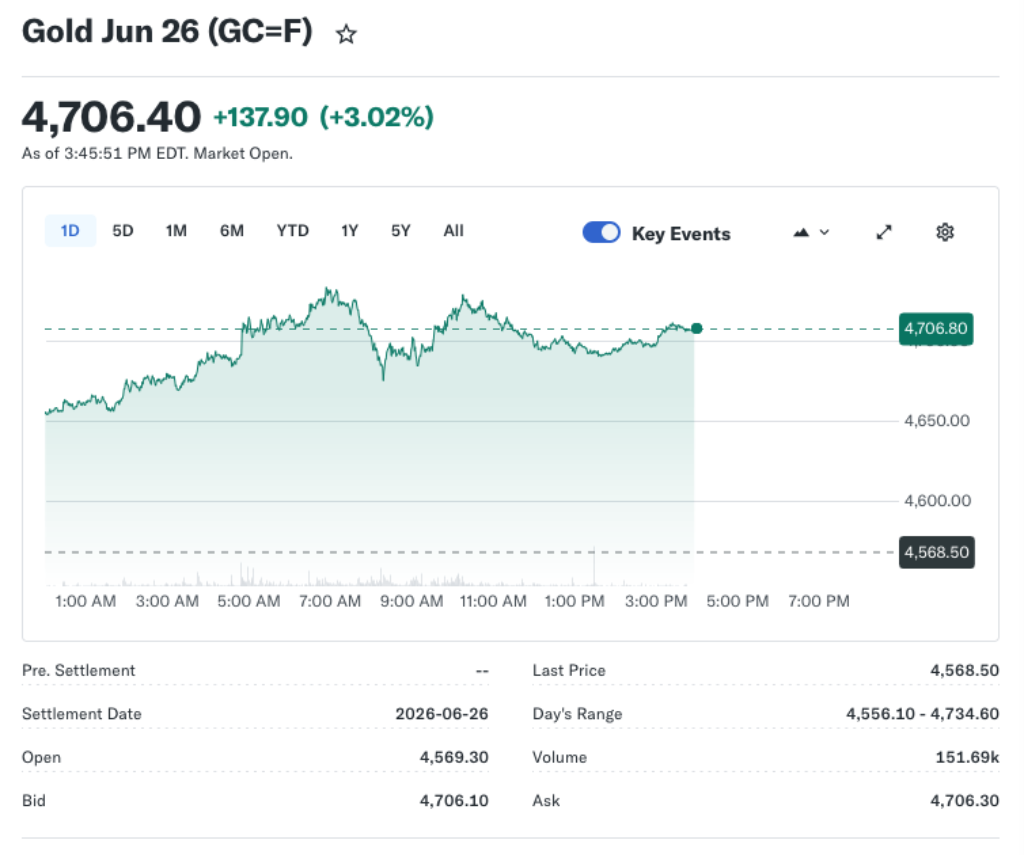
Gold recently tested resistance near $4,700 an ounce, and according to analysts at Morgan Stanley, that could be just the beginning of a much larger climb.
Amy Gower, Morgan Stanley Research’s Metals and Mining Commodity Strategist, reaffirmed her bullish stance on gold, forecasting that the yellow metal could reach $5,200 by the end of the year.
That represents a roughly ten percent jump from current levels, marking renewed optimism for the world’s oldest safe-haven asset.
Here's What They're Not Telling You About Your Retirement
Gower acknowledged that gold’s recent struggle has caught some investors off guard, particularly with ongoing conflict in Iran rattling energy markets.
However, she pointed out that the relationship between geopolitics and gold prices has shifted as central banks, especially the Federal Reserve, continue to dominate investor psychology.
“With the conflict triggering an energy supply shock that has reduced hopes for lower U.S. interest rates, it is not surprising that gold has struggled to work as a safe haven this time,” Gower said. According to her, gold’s safe-haven reputation has been temporarily overshadowed by its sensitivity to monetary policy.
Gower explained that gold prices today are reflecting not just immediate crises, but more importantly, the policy reactions those crises provoke. “Gold’s sensitivity to monetary policy has taken over as the key price driver,” she noted.
This Could Be the Most Important Video Gun Owners Watch All Year
“This has overshadowed its safe-haven status and reduced its effectiveness as a hedge against both geopolitical and inflation risks.”
High oil prices, driven by war-related supply disruptions, have reignited inflation pressures and forced the Federal Reserve to rethink its interest rate plans. While earlier in the year markets had penciled in multiple rate cuts, traders have now priced in fewer due to persistent inflationary factors.
Still, Morgan Stanley maintains a relatively dovish forecast. The firm expects the Fed to deliver one rate cut in January followed by another in March 2027, which would relieve some of the pressure on real yields and, consequently, support higher gold prices.
“Gold is likely to remain sensitive to real yields, but we see room for further upside,” Gower added. Lower yields reduce the opportunity cost of holding non-yielding assets like gold, making it more attractive to investors seeking preservation of capital amid policy uncertainty.
ETF flows could be another major catalyst. Gower noted that gold-backed ETFs are especially reactive to policy signals and can significantly amplify price swings when sentiment shifts. If rate cuts proceed as expected, investment flows into ETFs could accelerate, further lifting prices.
Meanwhile, geopolitical instability remains a wild card. Market participants are watching developments in the Middle East closely as any escalation or resolution could move energy prices sharply, which in turn affects inflation expectations and central bank policy.
Overnight, President Donald Trump stated that important progress was being made toward a lasting peace agreement in the region.
Should those negotiations succeed, Gower suggests, the global economy might quickly recover from the current energy supply shock. However, she cautioned that an extended conflict could keep gold volatile and unpredictable.
“Gold prices may suffer if markets begin to anticipate prolonged rate holds or even hikes,” she warned.
“At the same time, upside in a resolution scenario could be limited, as already elevated prices may constrain demand from ETFs, central banks and consumers.”
That delicate balance of forces underscores the complexity of today’s gold market. The precious metal has always been both a barometer of fear and a gauge of long-term monetary credibility.
In a world where central banks walk a fine line between inflation control and growth management, gold remains a mirror reflecting both inflation expectations and faith in fiat currencies.
For seasoned investors, the message is clear: gold’s next move will hinge not only on geopolitics but on central bank behavior. As long as inflation remains sticky and global uncertainty high, gold’s attraction as a stable store of value is unlikely to fade.
If Morgan Stanley’s outlook proves accurate, the coming year could see fresh enthusiasm in the gold sector—not only from retail investors but also from institutional funds seeking refuge from currency debasement and policy missteps.
History has shown that during times of shifting monetary power and geopolitical strain, few assets have managed to hold their ground like gold.
And with $5,200 appearing on the horizon, the yellow metal may once again remind markets why it has endured for centuries as money in its most honest form.
DISCLAIMER: GoldInvestors.news is not a registered investment, legal or tax advisor or broker/dealer. All investment/financial opinions expressed by GoldInvestors.news are from the personal research and experience of the owner of the site and are intended as educational material. Although best efforts are made to ensure that all information is accurate and up to date, occasionally unintended errors and misprints may occur.
Join the Discussion
COMMENTS POLICY: We have no tolerance for messages of violence, racism, vulgarity, obscenity or other such discourteous behavior. Thank you for contributing to a respectful and useful online dialogue.