DISCLAIMER: GoldInvestors.news is not a registered investment, legal or tax advisor or broker/dealer. All investment/financial opinions expressed by GoldInvestors.news are from the personal research and experience of the owner of the site and are intended as educational material. Although best efforts are made to ensure that all information is accurate and up to date, occasionally unintended errors and misprints may occur.
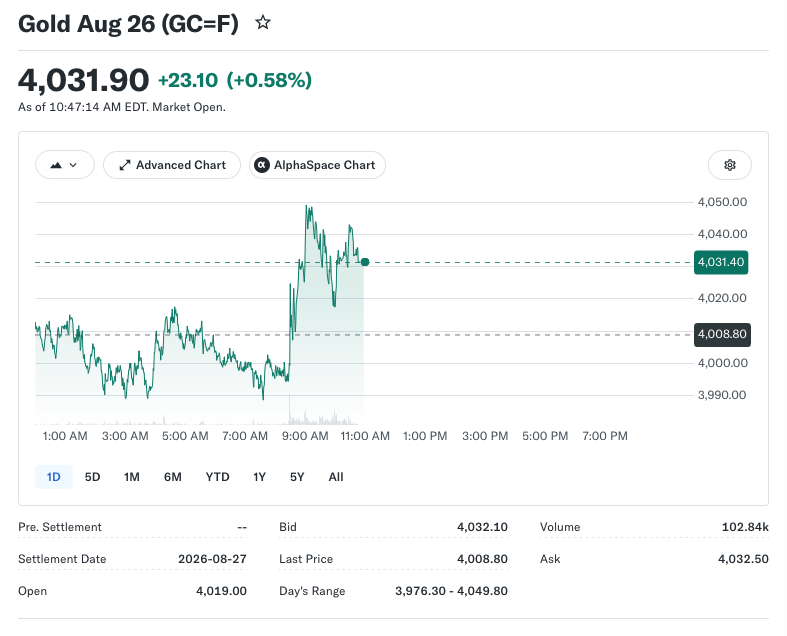
Gold prices steadied above the $4,000 mark on Thursday as investors regrouped from a four-session decline and reassessed the shifting outlook for U.S. interest rates.
The Federal Reserve’s stance has reset market expectations, leaving investors recalibrating their positions across commodities, equities, and bonds.
Spot gold edged up 0.36 percent to trade near $4,012.80 an ounce, while silver climbed 1.44 percent to around $58.13, as bargain hunters stepped in following the recent selloff.
Though these gains are modest, they signal renewed appetite for physical metals among investors looking for stability amid uncertain policy signals from Washington.
Here's What They're Not Telling You About Your Retirement
The latest Personal Consumption Expenditures (PCE) data for May slightly cooled inflation fears but failed to eliminate the Fed’s tightening pressure on metals.
The index rose 0.4 percent on the month and 4.1 percent from a year earlier, aligning with forecasts and marginally below the 0.5 percent monthly projection. While the numbers were not alarming, they were high enough to keep rate hike expectations alive.
Equity traders breathed a sigh of relief as the inflation reading didn’t exceed forecasts.
Tech-heavy Nasdaq 100 futures jumped 2.3 percent, and the S&P 500 gained 0.8 percent, while Dow futures ticked higher by 0.2 percent.
This Could Be the Most Important Video Gun Owners Watch All Year
That brief optimism helped reduce immediate fears of another aggressive rate move this summer.
Still, the market remains heavily influenced by the Federal Reserve’s June 17 decision.
Despite the central bank leaving rates unchanged between 3.50 and 3.75 percent, its updated projections suggest at least one more potential rate hike before the end of the year. Nine of twelve FOMC members now expect higher rates through 2026, effectively cutting short hopes of a dovish pivot.
For gold and silver, those shifting expectations carry real consequences. Higher real interest rates typically pressure non-yielding assets like precious metals, making them less competitive relative to dollar-based or Treasury-linked assets.
However, investors often return to metals when macro and geopolitical uncertainty remains high, and that safety component is still in play.
The geopolitical situation in the Strait of Hormuz is also weighing on market psychology. Earlier fears of a closure spike have now eased as tanker traffic surged to the highest level since February.
Brent crude prices retreated to $72.24 a barrel, returning to pre-escalation levels. That rapid normalization has softened energy-related inflation worries and reduced the emergency safe-haven premium previously built into gold.
Even so, traders remain cautious. The U.S.-Iran ceasefire is fragile, and energy supply chains are far from fully secure. If tensions flare again, both crude and gold could surge quickly, undoing the calm seen this week.
This uncertain backdrop keeps gold appealing for investors wary of how quickly peace agreements can unravel in the region.
At the same time, the U.S. dollar has firmed again near the 101.64 level, supported by hot Treasury yields hovering around 4.4 percent on the 10-year note.
A strong dollar traditionally works against gold, yet the metal’s resilience above $4,000 suggests underlying demand from investors unconvinced by the “soft landing” narrative promoted by central bankers.
Technically, analysts see $4,023 and $4,090 as key resistance levels that must be broken to push toward $4,357 or even $4,597 in the near term.
On the downside, the bears are watching $3,900 and $3,830 closely, with deeper targets extending toward $3,800 if momentum fades. These technical barriers have become more significant as trading volumes surge and volatility returns to metals.
For silver, the setup looks similar but slightly more bullish in tone. Bulls are targeting a climb above the $59.62 to $62.00 range, which could open the path to $71.49 and then $72.00.
On the downside, a drop through $57.20 could trigger heavier liquidation toward $53.40 or even $51.26. Traders note that silver often lags gold during rate hikes but can outperform when policy turns toward easing or instability returns to broader markets.
With monetary tightening likely still on the table, gold’s strength above the $4,000 level reveals ongoing skepticism toward the Fed’s claim that inflation risks are fully contained.
Investors appear to view gold not just as a hedge against inflation, but also as insurance against policy missteps and geopolitical surprises.
For now, both the gold and silver markets reflect a delicate balance between fading panic and persistent caution. Traders walk a fine line—respecting the power of the Fed’s stance while keeping an eye on the fragility of global peace and the durability of the dollar’s strength.
In an environment where central banks continue to call the shots, physical metals remain the one asset class still anchored in tangible value.
DISCLAIMER: GoldInvestors.news is not a registered investment, legal or tax advisor or broker/dealer. All investment/financial opinions expressed by GoldInvestors.news are from the personal research and experience of the owner of the site and are intended as educational material. Although best efforts are made to ensure that all information is accurate and up to date, occasionally unintended errors and misprints may occur.
Join the Discussion
COMMENTS POLICY: We have no tolerance for messages of violence, racism, vulgarity, obscenity or other such discourteous behavior. Thank you for contributing to a respectful and useful online dialogue.