DISCLAIMER: GoldInvestors.news is not a registered investment, legal or tax advisor or broker/dealer. All investment/financial opinions expressed by GoldInvestors.news are from the personal research and experience of the owner of the site and are intended as educational material. Although best efforts are made to ensure that all information is accurate and up to date, occasionally unintended errors and misprints may occur.
The gold market is struggling to find a footing after surrendering the $5,000 level, a psychological milestone that many traders watched as a critical test of demand.
Investors observed persistent selling pressure through the overnight session, widening the corridor of uncertainty and raising the odds of additional downside moves in coming sessions.
With momentum shifting, traders cite mounting headwinds from an inflation backdrop that remains stubbornly persistent in the United States, despite occasional relief rallies in other risk assets.
The latest data shows producer prices climbing more than expected, underscoring cost pressures across the economy and hinting at a broader pattern of price discipline that could complicate policy normalization.
Here's What They're Not Telling You About Your Retirement
February's producer price index rose 0.7 percent, extending a pattern of hotter inflation readings that has persisted for multiple months.
That acceleration reinforces concerns that price pressures may prove sticky, putting pressure on real yields and bullion demand in the near term.
From a technical standpoint, the $5,000 level had acted as a fulcrum for buyers, a psychological anchor that drew physical and speculative participants into the market.
Once breached, it invites a cascade of stop losses and liquidations that can accelerate downside, particularly when momentum indicators back the move.
This Could Be the Most Important Video Gun Owners Watch All Year
Beyond the immediate price action, investors are weighing the macro backdrop, including expectations for how central banks will respond to a stubborn inflation regime.
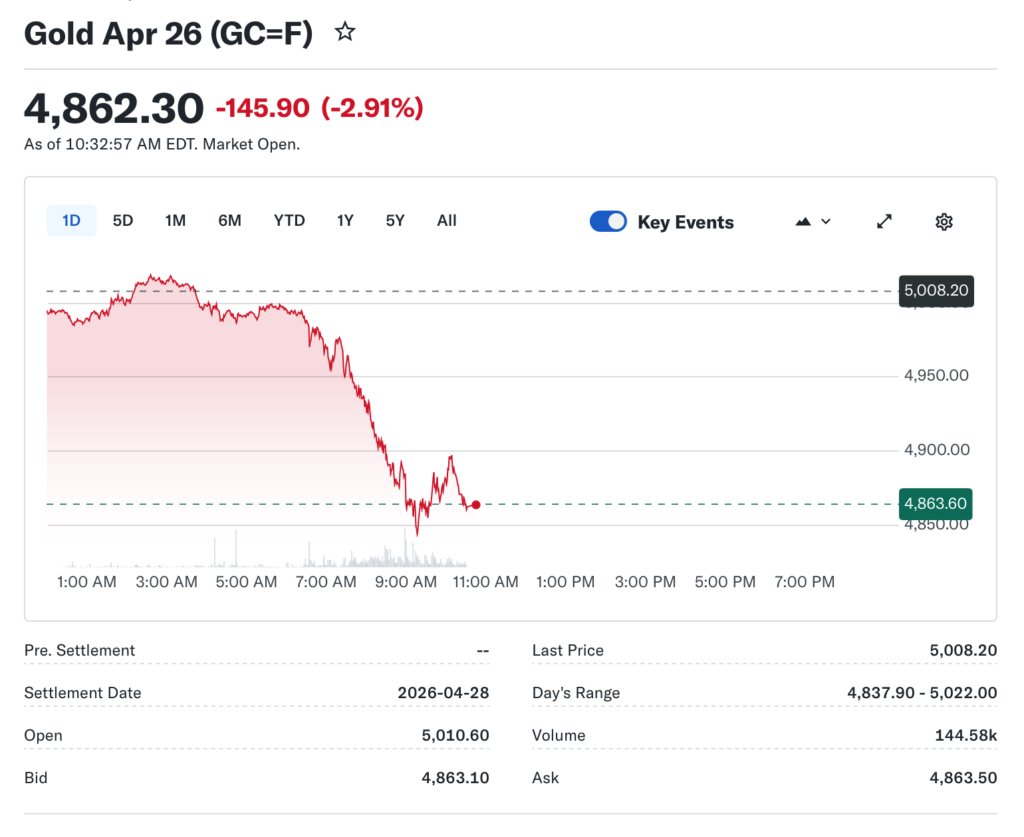
If inflation stays hot, the risk premium on gold could normalize higher, yet near term momentum remains unfavorable.
Gold's bid has been capped by competing forces, including rising yields and a firmer dollar that makes non-yielding assets less attractive to range traders and longer term buyers alike.
As real yields push higher, non-yielding assets like bullion have a tougher time attracting fresh buyers, even as some demand from physical markets and safe-haven flows persists.
The broader market narrative still leans toward caution, as traders fret about the durability of the PPI surprise and what it implies for the inflation trajectory over the next several sessions.
Portfolio hedges and diversification remain focal points for risk managers seeking ballast against macro shifts that could alter asset correlations.
Market participants note that gold may need a clearer catalyst to reestablish its footing, whether that comes from cooling inflation prints, a softer energy backdrop, or a shift in central bank rhetoric.
Absent such catalysts, the metal trades in a range defined by macro headlines and the tug of competing financial forces.
Until then, volatility is likely to persist as traders recalibrate expectations for the path of interest rates and the trajectory of real yields.
Commerce, manufacturing, and consumer demand signals all feed into pricing and risk assessments for gold, shaping the willingness of buyers and sellers to step into the market.
Analysts vary in their timing, but many warn that a sustained break below $5,000 could redraw the technical landscape and alter the risk-reward calculus for both speculators and longer term holders.
Such a move would likely invite a period of consolidation as market participants reassess their exposure to inflation hedges and yield-driven assets.
On the demand side, physical buyers including jewelry producers and investment demand may temper their interest if costs stay elevated and price volatility lingers.
Yet central bank allocations and state-backed futures activity could underpin a floor if crisis sentiment returns, lending a counterweight to speculative selling.
The gold market remains at a crossroads, where stubborn inflation, policy signaling, and the tempo of wage and price data will decide the intermediate trend.
Traders would do well to remain disciplined, focusing on risk controls and the shape of the yield curve as they navigate this uncertain phase.
DISCLAIMER: GoldInvestors.news is not a registered investment, legal or tax advisor or broker/dealer. All investment/financial opinions expressed by GoldInvestors.news are from the personal research and experience of the owner of the site and are intended as educational material. Although best efforts are made to ensure that all information is accurate and up to date, occasionally unintended errors and misprints may occur.
Join the Discussion
COMMENTS POLICY: We have no tolerance for messages of violence, racism, vulgarity, obscenity or other such discourteous behavior. Thank you for contributing to a respectful and useful online dialogue.