DISCLAIMER: GoldInvestors.news is not a registered investment, legal or tax advisor or broker/dealer. All investment/financial opinions expressed by GoldInvestors.news are from the personal research and experience of the owner of the site and are intended as educational material. Although best efforts are made to ensure that all information is accurate and up to date, occasionally unintended errors and misprints may occur.
Gold is often celebrated as the ultimate safe haven, a solid anchor for investors during global turmoil.
Yet its behavior during the Iran war has puzzled many observers.
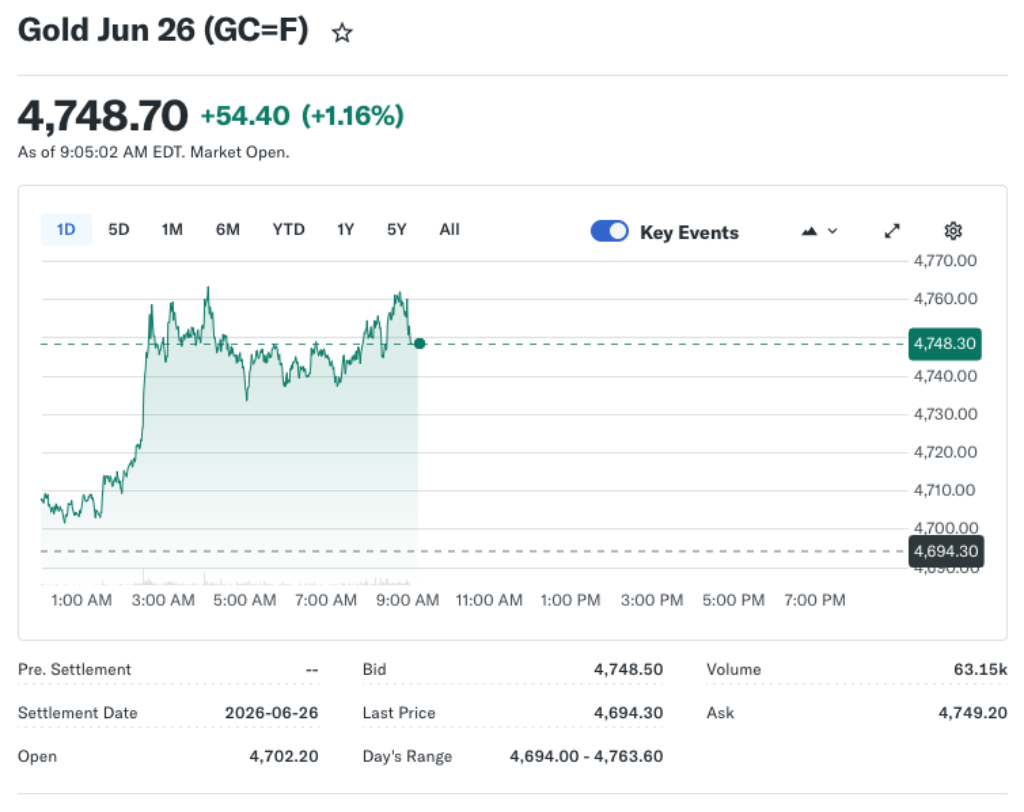
Despite one of the most significant geopolitical shocks in recent history, gold’s price has not soared as expected.
Instead, it has fallen nearly 10 percent in just ten weeks, leaving many wondering whether the metal has lost its edge as a crisis hedge.
Here's What They're Not Telling You About Your Retirement
But according to market analysts, gold’s uncharacteristic decline may actually reveal that it is doing one of its most essential jobs — supporting global liquidity and enabling access to U.S. dollars when traditional funding channels seize up.
Kristian Kerr, head of macro strategy at LPL Financial, argues that gold’s current function is far more nuanced than its safe-haven reputation suggests.
“Understanding why requires stepping back and recognizing that gold does not sit neatly in any one asset category,” he explained. “It actually straddles several as gold simultaneously functions as a commodity, a reserve asset, and a currency surrogate.”
This distinction, Kerr noted, helps explain the metal’s muted price performance. Rather than serving strictly as a hedge against chaos, gold is now being mobilized as a source of dollar liquidity for nations facing severe economic disruption.
This Could Be the Most Important Video Gun Owners Watch All Year
The Iran war’s impact on global energy markets has been profound. Countries dependent on oil exports are contending with revenue shortfalls as supply routes are disrupted and demand fluctuates.
Some of these governments have reportedly turned to their gold reserves, selling or swapping holdings to secure access to the U.S. dollar — the currency that still dominates international trade and finance.
“Selling or swapping gold holdings provides immediate access to the currency that still sits atop the global funding hierarchy: the U.S. dollar,” Kerr said.
“This helps explain gold’s unusual price action. Rather than seeing pure safe‑haven flows, we are likely getting official and semi-official supply, as some countries have been forced to monetize gold reserves to bridge revenue gaps created by disrupted oil exports.”
This activity puts selling pressure on gold, keeping prices subdued even as investors seek safety. The metal’s decline is therefore not a failure of function but evidence of a different kind of success — serving as a reliable financial instrument for nations under stress.
Treasury Secretary Scott Bessent acknowledged in early April that the Iran conflict intensified the liquidity demand among U.S. allies in the Persian Gulf. Dollar shortages have squeezed several regional economies, prompting them to use gold as collateral or direct funding support.
“In those moments, gold can function as less of a hedge and more as a balance sheet resource,” Kerr noted. “That framing is critical. Gold is not failing in its role. It is simply being used.”
His comments align with a broader recognition that the global economy remains anchored by access to dollar funding, and gold is one of the few liquid international assets capable of bridging that gap.
Even if peace talks gain traction and the Iran war winds down, Kerr expects continued volatility for gold. He cautioned that recovery from a major energy shock often brings lingering instability in supply chains, rebuilding costs, and fluctuating currency flows.
“Until dollar funding pressures ease and energy flows normalize, gold may continue to trade less like a geopolitical hedge and more like a balance sheet asset,” he said.
The metal’s dual identity — part investment, part liquidity mechanism — ensures that its market behavior will remain complex for the foreseeable future.
MORE NEWS: SpaceX Rockets Into Nasdaq-100 as Fast-Tracked Inclusion Sparks Massive ETF Buying Frenzy
For individual investors, the current episode is a reminder that gold’s value extends beyond short-term price moves. The metal’s ultimate strength lies in its capacity to perform multiple roles within the global financial system.
It can hedge against inflation, store value for the long term, and serve as a backstop for governments or central banks in times of crisis.
What the Iran war reveals is that gold’s financial utility may actually increase in periods of market and political chaos, even if its price does not respond in classic fashion.
A falling gold price, paradoxically, may signal that the metal is doing precisely what it should — facilitating liquidity where it is needed most.
For hard-asset advocates, this episode reinforces the lesson that gold’s importance cannot be measured by price alone.
It remains one of the few forms of real money not tied to a central bank or government mandate, and that intrinsic independence continues to make it a cornerstone of global stability, even in a time of war.
DISCLAIMER: GoldInvestors.news is not a registered investment, legal or tax advisor or broker/dealer. All investment/financial opinions expressed by GoldInvestors.news are from the personal research and experience of the owner of the site and are intended as educational material. Although best efforts are made to ensure that all information is accurate and up to date, occasionally unintended errors and misprints may occur.
Join the Discussion
COMMENTS POLICY: We have no tolerance for messages of violence, racism, vulgarity, obscenity or other such discourteous behavior. Thank you for contributing to a respectful and useful online dialogue.