DISCLAIMER: GoldInvestors.news is not a registered investment, legal or tax advisor or broker/dealer. All investment/financial opinions expressed by GoldInvestors.news are from the personal research and experience of the owner of the site and are intended as educational material. Although best efforts are made to ensure that all information is accurate and up to date, occasionally unintended errors and misprints may occur.
Gold’s long-standing role as a hedge against global instability is intensifying as investors and nations alike look for refuge from mounting geopolitical and fiscal turmoil.
Chris Mancini, co-portfolio manager of the Gabelli Gold Fund (GLDAX), argues that an era of de-dollarization is underway and that gold is positioned to become the world’s dominant alternative to the U.S. dollar, with a price climb above $6,000 per ounce firmly on the horizon.
Speaking with Kitco News, Mancini attributed gold’s recent pullback to temporary selling pressure from oil-exporting nations affected by the ongoing conflict in Iran.
He said Turkey and the Gulf states may be drawing on gold reserves to fund government operations while energy exports are constrained, but noted that this dynamic only reinforces gold’s value as the most reliable liquid asset in times of crisis.
Here's What They're Not Telling You About Your Retirement
“Gold is doing exactly what it’s supposed to do—it serves its purpose when nations or investors need quick liquidity,” Mancini explained. “Unlike bonds or currencies, gold belongs fully to the holder.”
He emphasized the simplicity of this ownership as central to gold’s enduring power. When an investor buys gold, they own an asset that carries no counterparty risk.
“Gold is an asset that is no one’s liability,” Mancini said. “When you buy a Treasury or bond, you are lending to a government. When you buy gold, you simply own it outright.”
According to Mancini, that distinction will become increasingly crucial as Western governments grapple with record levels of debt and expanding deficits tied to rising defense budgets.
This Could Be the Most Important Video Gun Owners Watch All Year
“As debts and deficits grow, gold tends to become more attractive,” he noted. “Increased defense spending will likely reinforce that trend.”
He places today’s developments in the broader context of a major shift in the structure of the international financial order. The Russia-Ukraine conflict, and especially the United States’ freezing of Russian Treasury holdings, sent a chilling signal to countries holding large dollar reserves. That, Mancini said, pushed central banks around the world to reconsider whether lending to Washington through Treasury purchases remains a safe bet.
“When the U.S. seized Russian Treasuries, it was effectively admitting that those assets were not truly sovereign property anymore,” Mancini said. “That realization helped drive gold from roughly $2,000 an ounce toward $5,000.” The event catalyzed what he calls a “paradigm shift” in global reserves policy—a turn toward gold and away from the U.S. dollar.
Now, with tensions escalating in the Middle East and defense budgets ballooning across Europe and America, the risk of fiscal overreach and inflationary spillovers is deepening.
Mancini views this environment as fertile ground for further gold appreciation. He suggested that key surplus nations like China, Saudi Arabia, and others may no longer be willing to recycle earnings into U.S. debt instruments. “Running a surplus used to mean buying Treasuries,” he said. “But countries may soon decide they would rather hold neutral stores of value. That means gold.”
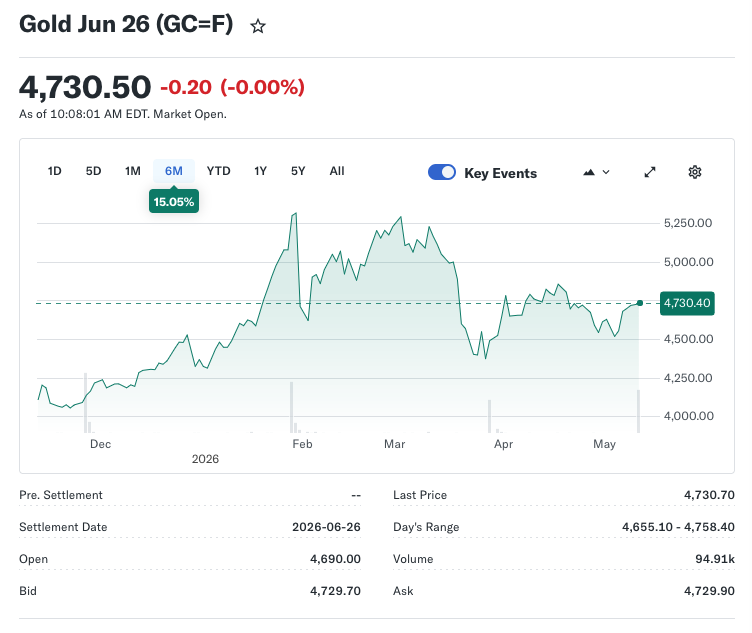
The Gabelli manager sees the precious metal’s correction from roughly $5,300 per ounce as a pause before another leg higher. Once geopolitical panic subsides and the structural drift away from the dollar stabilizes, he expects gold to push past $6,000.
The timeline may hinge partly on how global reserve managers adjust to the emerging “new world order” that policymakers have been referencing.
Mancini’s thesis dovetails with an accelerating move among central banks to acquire record volumes of bullion. Nations such as China, Poland, and Singapore have been prominent buyers, using gold to diversify away from dollar exposure.
The yellow metal’s appeal lies not just in its historical role as money, but in its unique ability to exist outside the reach of sanctions or central bank manipulation.
For investors, the same logic applies. In a world where government liabilities expand unchecked and fiat currencies suffer from political interference, gold remains an instrument of personal sovereignty.
Its value flows from independence, transparency, and scarcity—all qualities increasingly scarce in modern finance.
Spot gold showed renewed volatility on Tuesday, dipping to a session low near $4,607 before bouncing back above $4,653—barely a tenth of a percent higher on the day. That small move belies the deeper currents of distrust in fiat markets that are pushing long-term holders to maintain or add to positions.
The question now is whether the market’s growing conviction in gold’s primacy will produce the next supercycle.
If Mancini’s forecast proves right, today’s price chop could be the final accumulation phase before the world’s oldest form of money reclaims its preeminence in global trade.
Investors who understand that this is not just a price story—but a political and monetary one—may see gold as less of a trade and more of an escape from the system itself.
DISCLAIMER: GoldInvestors.news is not a registered investment, legal or tax advisor or broker/dealer. All investment/financial opinions expressed by GoldInvestors.news are from the personal research and experience of the owner of the site and are intended as educational material. Although best efforts are made to ensure that all information is accurate and up to date, occasionally unintended errors and misprints may occur.
Join the Discussion
COMMENTS POLICY: We have no tolerance for messages of violence, racism, vulgarity, obscenity or other such discourteous behavior. Thank you for contributing to a respectful and useful online dialogue.