DISCLAIMER: GoldInvestors.news is not a registered investment, legal or tax advisor or broker/dealer. All investment/financial opinions expressed by GoldInvestors.news are from the personal research and experience of the owner of the site and are intended as educational material. Although best efforts are made to ensure that all information is accurate and up to date, occasionally unintended errors and misprints may occur.
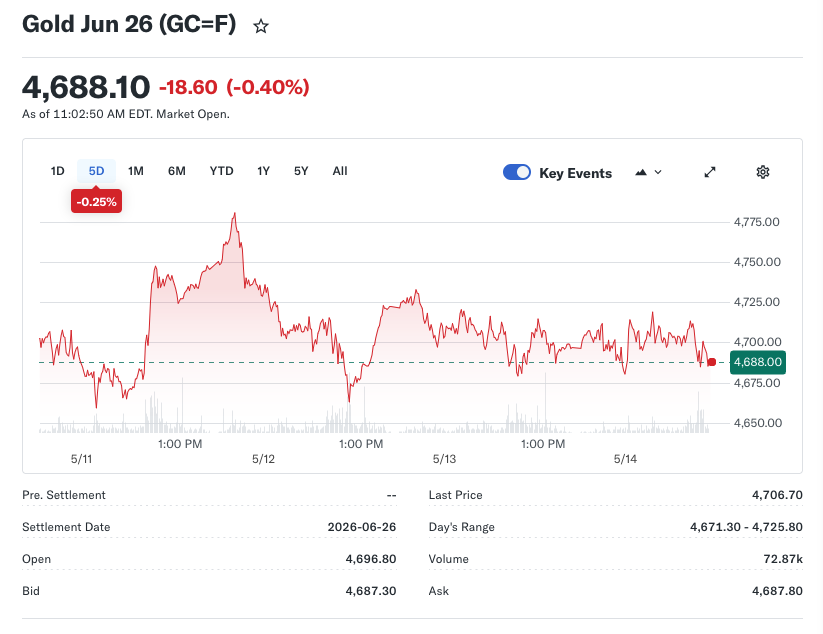
Gold prices are showing resilience as the metal continues to hover around the $4,700 level, even as U.S. retail sales data suggest the economy remains active but may be losing momentum.
The Commerce Department reported that retail sales rose 0.5% in April following a strong 1.6 percent gain in March, hinting that consumers are still spending, but perhaps more cautiously.
The latest figures marked a 4.9% increase from April of the previous year, largely in line with market forecasts.
Core sales, excluding volatile automotive transactions, increased by 0.7% for the month, matching economists’ expectations. Despite the steady numbers, analysts noted that the inflation-adjusted story looks less upbeat, as higher prices continue to eat into purchasing power.
Here's What They're Not Telling You About Your Retirement
Gold’s muted reaction to these figures reflects a market caught between conflicting forces. Spot gold traded last at $4,705.37 per ounce, up 0.35 percent on the day, as traders weighed signs of moderating demand against ongoing inflation pressures.
For many investors, the yellow metal remains the ultimate hedge, even as the Federal Reserve continues to signal a firm stance on rates.
The control group of retail sales, a measure that feeds directly into gross domestic product calculations by excluding categories like auto dealers and gas stations — rose 0.5 percent versus a forecast of 0.4%.
While modest, that uptick suggests consumption is still forward-moving, at least nominally. However, without inflation adjustments, it tells an incomplete story.
This Could Be the Most Important Video Gun Owners Watch All Year
Economists have pointed out that when adjusted for rising prices, real consumer activity is likely far softer than the headline data imply.
The inflation report earlier in the week showed another significant jump in consumer prices, intensifying fears that the United States could be slipping toward a moderating economy combined with persistently high inflation, the classic conditions for stagflation.
Those risks have drawn attention back to gold as both a hedge against currency devaluation and an anchor in uncertain monetary policy environments.
Many analysts are beginning to argue that the Federal Reserve’s tightening window is narrowing, with the economy showing strain under higher borrowing costs. If growth continues to cool, policymakers will have limited room to maneuver without triggering deeper damage.
Even as rising interest rates typically weigh on non-yielding assets like gold, the metal’s recent strength suggests markets may be anticipating a shift.
Higher nominal rates combined with stubborn inflation create lower real yields, diminishing the opportunity cost of holding gold relative to bonds or cash. Investors who view this dynamic as a sign of long-term fiscal imbalance are turning again to hard assets.
The broader picture remains complex. On one hand, consumer spending, the backbone of the U.S. economy, has not collapsed.
On the other, much of that spending might now be sustained through credit, higher wages failing to keep pace with price increases, and savings rates that have drifted lower since the post-pandemic surge. That environment often fuels a cautious but steady move into stores of value.
Gold’s latest consolidation below recent peaks appears to be part of a healthy correction after a breakout run in recent months. Many traders see this level as a new floor rather than a ceiling, particularly as inflation remains stickier than expected.
Technical support near $4,700 has held firm, underscoring investor confidence that gold’s long-term fundamentals remain intact even amid short-term profit-taking.
Some market veterans argue that gold’s steadiness in the face of what would otherwise be bearish macro news reflects a growing distrust in fiat stability and central bank competence.
With sovereign debt climbing and inflationary pressures lingering, the market’s confidence in policymakers’ ability to thread the needle between inflation control and growth stability is waning.
As attention turns to the Federal Reserve’s upcoming meetings, investors will be watching closely for any tone shift that suggests awareness of softening economic activity.
If the Fed gives even a hint of dovish recalibration, that could ignite another leg higher for gold. Until then, the metal’s near-term range appears firm, supported by global demand and enduring uncertainty about the path forward.
In times like these, where inflation data and consumer patterns paint an uneasy picture, gold’s quiet strength may speak louder than market headlines.
Holding its line above $4,700 suggests the metal’s role as a refuge remains unshaken, with investors continuing to see value in certainty amid economic crosswinds.
DISCLAIMER: GoldInvestors.news is not a registered investment, legal or tax advisor or broker/dealer. All investment/financial opinions expressed by GoldInvestors.news are from the personal research and experience of the owner of the site and are intended as educational material. Although best efforts are made to ensure that all information is accurate and up to date, occasionally unintended errors and misprints may occur.
Join the Discussion
COMMENTS POLICY: We have no tolerance for messages of violence, racism, vulgarity, obscenity or other such discourteous behavior. Thank you for contributing to a respectful and useful online dialogue.