DISCLAIMER: GoldInvestors.news is not a registered investment, legal or tax advisor or broker/dealer. All investment/financial opinions expressed by GoldInvestors.news are from the personal research and experience of the owner of the site and are intended as educational material. Although best efforts are made to ensure that all information is accurate and up to date, occasionally unintended errors and misprints may occur.
The U.S. bond market lit up Friday morning as Treasury yields surged, rattling investors already uneasy over stubborn inflation and a murky Federal Reserve path under newly confirmed Chair Kevin Warsh.
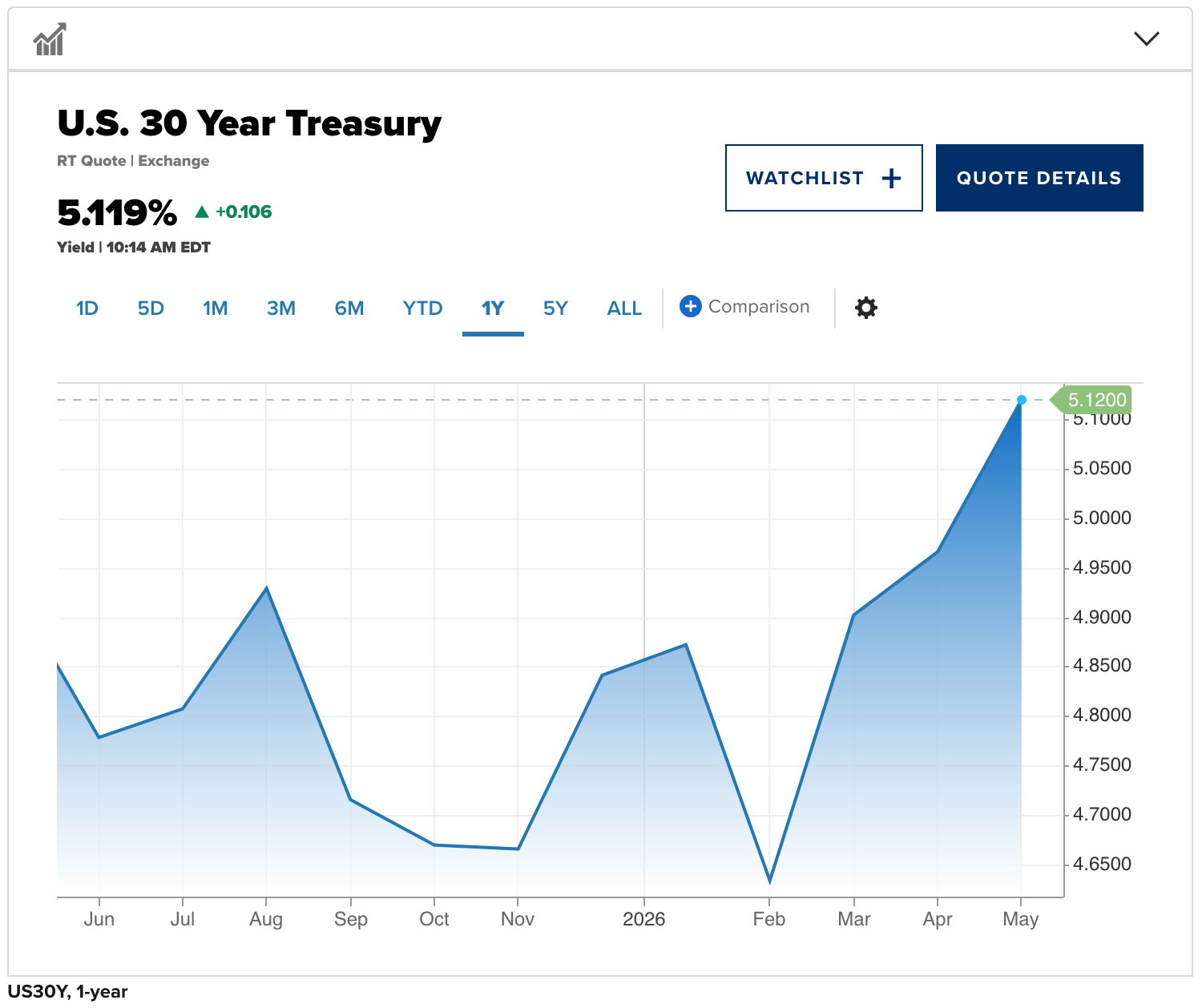
The 30-year Treasury yield pierced 5.1%, the highest level in nearly a year, sending a clear message that inflation is still smoldering and market confidence in easy-money policy is fading fast.
The 10-year Treasury note, the key gauge for U.S. borrowing costs, jumped to 4.55%, while the 2-year yield rose to 4.06%.
Bond prices fell sharply across maturities, reinforcing the view that the market is losing patience with Washington’s spending spree and the Fed’s hesitant approach to price pressures.
Here's What They're Not Telling You About Your Retirement
For investors, these rising yields are a double-edged sword. They offer some of the highest returns on Treasurys in years but also signal escalating debt costs and inflation risks that threaten both stocks and the broader economy.
The yield spike marks the steepest sell-off in long-term government bonds since last autumn, a time when fears of runaway deficits first began to dominate financial headlines.
The shift comes after a bruising week of inflation data. The latest Consumer Price Index showed prices climbing at a 3.8% annual rate, the hottest since May 2023, while producer prices spiked to a 6% annual pace, the worst since late 2022.
Add to that a 4.2% annual rise in import prices, driven by higher energy costs tied to ongoing Middle East tensions, and the problem becomes global.
This Could Be the Most Important Video Gun Owners Watch All Year
Oil prices added fresh fuel to the fire. West Texas Intermediate crude jumped more than three dollars to above $104 a barrel, and Brent crude climbed past $108.
Higher energy costs tend to ripple through the economy quickly, lifting everything from transportation costs to grocery bills, widening the Fed’s inflation challenge.
Newly seated Fed Chairman Warsh faces the unenviable task of stabilizing expectations without triggering market panic.
President Trump has been vocal in pressing for lower interest rates, arguing that growth is being constrained unnecessarily. However, with inflation climbing and debt-servicing costs exploding, Warsh may find little room to maneuver without losing credibility.
“Inflation is still a problem,” warned Peter Boockvar of One Point BFG Wealth Partners, adding that “debts and deficits matter” and that foreign holders of U.S. government bonds could become sellers if confidence wanes.
His remark that “long end rates are now in control of monetary policy” underscores how market forces are asserting themselves over central planning.
Even the Treasury’s own books reveal stress. The federal government posted a $215 billion surplus in April, typically a strong month due to tax inflows, but that was still 17% below the same month last year.
Interest on the national debt consumed $97 billion—second only to Social Security—showing how rising yields feed directly into ballooning deficits.
This fiscal squeeze may soon weigh on risk assets. Higher bond yields make it more expensive for corporations to borrow and for households to finance new homes, cars, and credit card balances.
Equity markets often buckle when the 10-year yield climbs sharply, as investors rotate toward safer fixed-income alternatives offering robust real returns.
The U.S. is not alone in feeling the pressure. German 10-year bunds traded above 3.12%, Japanese government bonds reached 2.69%, and U.K. gilts climbed over 4.56%.
Global central banks are converging on a disturbing reality: inflation may be far more structural and politically driven than the economists hoped.
Friday’s trading also coincided with upcoming reports on industrial production and New York’s manufacturing activity index, expected to shed light on whether tighter financial conditions are beginning to slow growth.
So far, consumer spending has held up, but wage pressures and higher import costs hint that inflation may stay persistent well into the summer.
For long-term investors, today’s bond market convulsions are a reminder that the era of cheap debt is ending.
Those depending on perpetual low rates to support overheated stock valuations are confronting a new landscape where fiscal recklessness and geopolitical uncertainty carry a steep premium.
The bottom line: with 30-year yields topping 5.1 percent and debt financing consuming ever larger portions of federal revenue, the U.S. economy is entering an unfamiliar phase of accountability.
Whether Kevin Warsh can tame inflation without breaking the market will define the next chapter in American monetary policy—and dictate the price of stability for years to come.
DISCLAIMER: GoldInvestors.news is not a registered investment, legal or tax advisor or broker/dealer. All investment/financial opinions expressed by GoldInvestors.news are from the personal research and experience of the owner of the site and are intended as educational material. Although best efforts are made to ensure that all information is accurate and up to date, occasionally unintended errors and misprints may occur.
Join the Discussion
COMMENTS POLICY: We have no tolerance for messages of violence, racism, vulgarity, obscenity or other such discourteous behavior. Thank you for contributing to a respectful and useful online dialogue.