DISCLAIMER: GoldInvestors.news is not a registered investment, legal or tax advisor or broker/dealer. All investment/financial opinions expressed by GoldInvestors.news are from the personal research and experience of the owner of the site and are intended as educational material. Although best efforts are made to ensure that all information is accurate and up to date, occasionally unintended errors and misprints may occur.
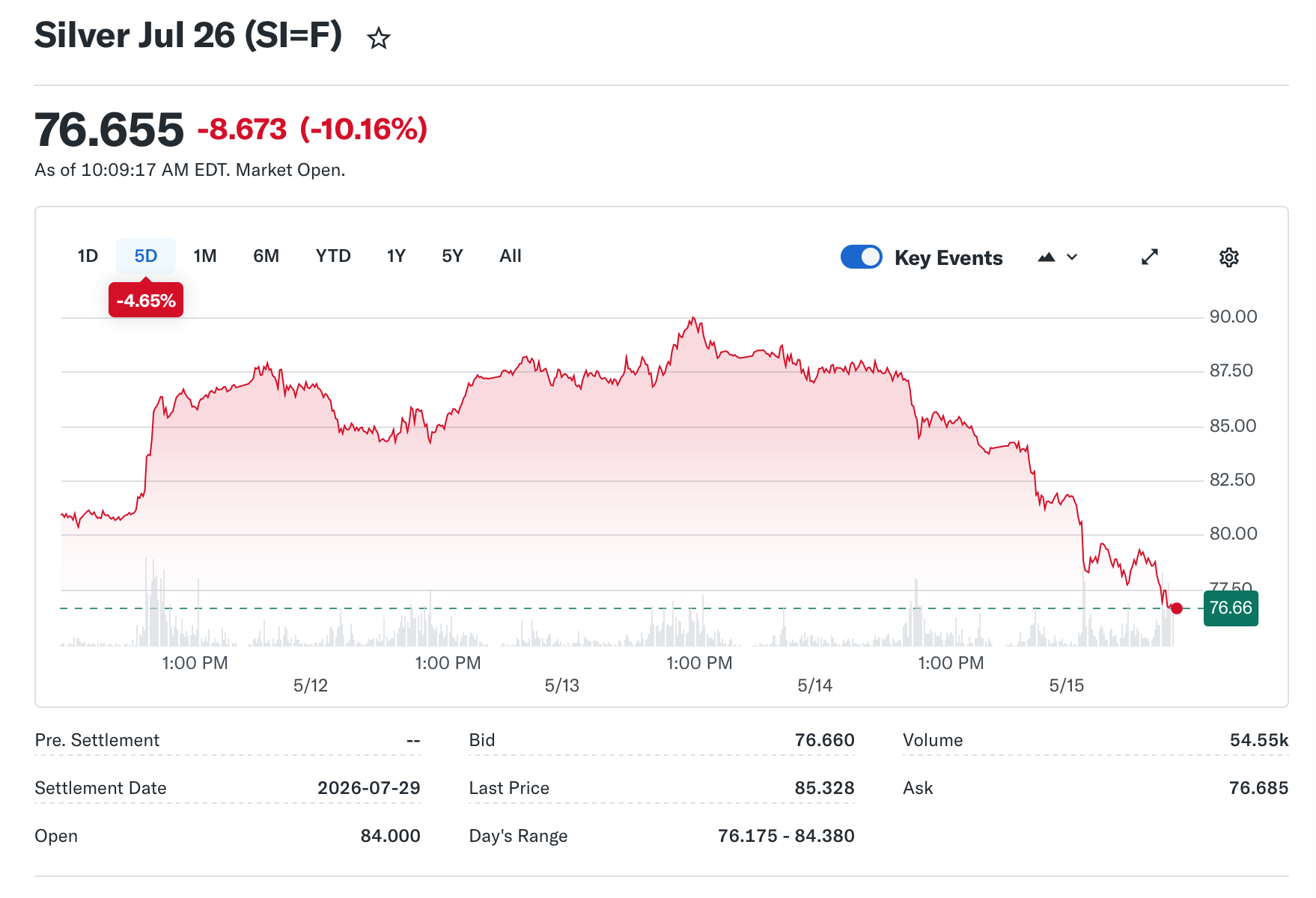
Silver took a hard fall on Thursday, tumbling nearly 5% as surging Treasury yields and a firmer U.S. dollar dealt a heavy blow to the metals market.
Despite a flare-up in geopolitical tension in the Strait of Hormuz—a situation that typically sparks defensive buying—investors turned away from silver, focusing instead on higher-yielding opportunities.
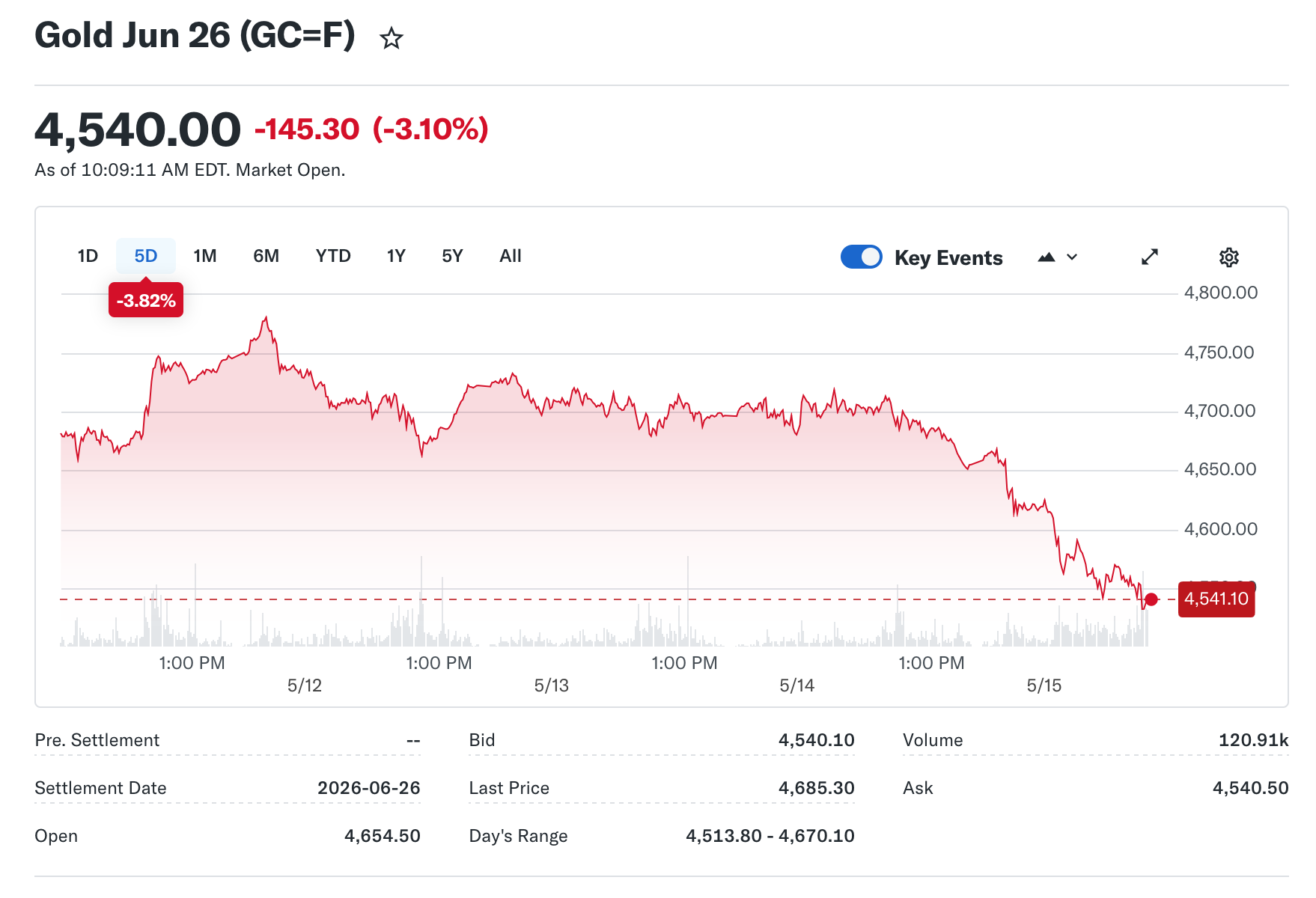
Gold, meanwhile, held its ground above $4,650 an ounce, showing some resilience even as it faced similar headwinds.
Spot gold ended 0.8% lower at $4,650.30, while spot silver sank a sharp 4.58% to $83.36, marking its steepest one-day decline since March.
Here's What They're Not Telling You About Your Retirement
The selloff came as Treasury yields extended gains, pushing the benchmark 10-year note near the 4.5% level.
Those higher yields, along with a stronger dollar, tend to pressure precious metals that pay no interest. Investors often rotate into income-producing assets when they expect monetary policy to stay tight.
Economic data offered a mixed picture. April retail sales rose 0.5% to $757.1 billion, following a solid 1.6% increase in March, suggesting consumer spending remains healthy.
This Could Be the Most Important Video Gun Owners Watch All Year
But the jobs data told another story: initial jobless claims rose by 12,000 to 211,000, and continuing claims added 24,000 to reach 1.782 million. That combination signals a softening labor market without providing the weakness that would pressure the Federal Reserve to pivot on rates.
The result has been an uneasy balance. Consumption continues to hold up, yet the persistent strength in yields keeps non-yielding assets like gold and silver on edge.
Many traders suspect the Fed will remain cautious, allowing inflationary pressures to linger longer than markets initially expected.
At the same time, global risk factors have not disappeared. Renewed turmoil in the Strait of Hormuz is once again rattling traders.
Reports indicate that a ship anchored off the coast of Fujairah was seized and taken toward Iranian-controlled waters, while another Indian-flagged vessel sank near Oman following an attack.
With roughly one-fifth of the world’s oil supply once moving through this channel, any destabilization raises both energy and inflation risk.
Iran continues to assert sovereignty over the waterway, while U.S. and Chinese officials insist that the passage remain open.
For markets, that standoff is becoming a recurring flashpoint that feeds volatility across energy, shipping, and inflation-sensitive assets.
In energy markets, crude prices are holding firm. Nymex WTI closed near $100.93 a barrel and Brent crude at $106.37, further contributing to inflation expectations. These elevated prices keep Treasury yields buoyant and weigh on metals. The dollar, as investors’ preferred safe haven, is also gaining strength.
Overall, U.S. equity markets shrugged off the noise. The S&P 500 climbed 0.8% to hit a record 7,501.24, while the Dow Jones Industrial Average rose 0.7% to 50,063.46.
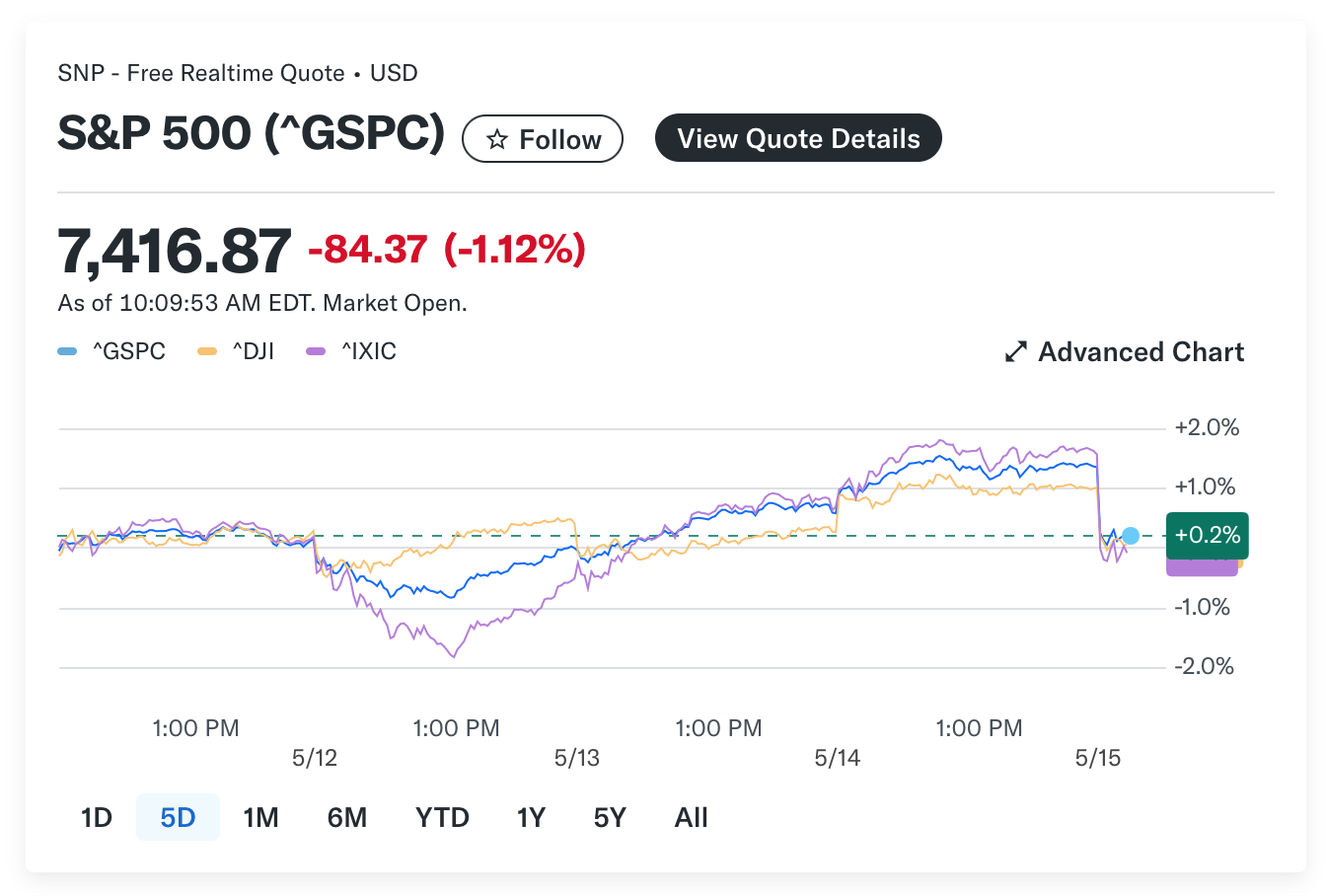
The Nasdaq Composite jumped 0.9% to 26,635.22. It’s an unusual divergence: risk assets marching higher even as economic uncertainty grows and commodities retreat.
On the futures side, Comex gold for May delivery settled at $4,678.10 per troy ounce, down 0.42%, while Comex silver closed down 4.47% at $84.912.
Technical traders view this as an inflection point. Spot gold now faces resistance between $4,711 and $4,723 per ounce, with a potential target of $4,774 if bulls regain control. On the downside, support sits at $4,686, with the next critical level at $4,561.
Silver’s technical landscape looks more fragile. To regain momentum, silver bulls must push the price back above $84.90. A rebound past $85.75 could indicate renewed buying interest, but a failure to hold $83.15 risks deeper losses to $82.25 or even $80.63.
The current dynamic reflects a market still testing its boundaries. Inflation fears and geopolitical tension create a bid for safety, but rising yields and a firm dollar undercut that instinct.
Gold has proven it can weather both inflation and rate worries, at least for now, while silver remains more sensitive to broader risk sentiment.
Traders are watching closely for any shift in Fed rhetoric or a surprise in upcoming inflation data.
For those focused on long-term value, price weakness in silver may eventually open new buying opportunities once yields stabilize. But in the short run, volatility remains the name of the game.
In a world where money supply expansion, energy disruptions, and fiscal contradictions collide, metals like gold continue to serve as a barometer of monetary sanity.
Thursday’s session shows that balance still hangs by a thread—one that global markets are gripping tightly.
DISCLAIMER: GoldInvestors.news is not a registered investment, legal or tax advisor or broker/dealer. All investment/financial opinions expressed by GoldInvestors.news are from the personal research and experience of the owner of the site and are intended as educational material. Although best efforts are made to ensure that all information is accurate and up to date, occasionally unintended errors and misprints may occur.
Join the Discussion
COMMENTS POLICY: We have no tolerance for messages of violence, racism, vulgarity, obscenity or other such discourteous behavior. Thank you for contributing to a respectful and useful online dialogue.