DISCLAIMER: GoldInvestors.news is not a registered investment, legal or tax advisor or broker/dealer. All investment/financial opinions expressed by GoldInvestors.news are from the personal research and experience of the owner of the site and are intended as educational material. Although best efforts are made to ensure that all information is accurate and up to date, occasionally unintended errors and misprints may occur.
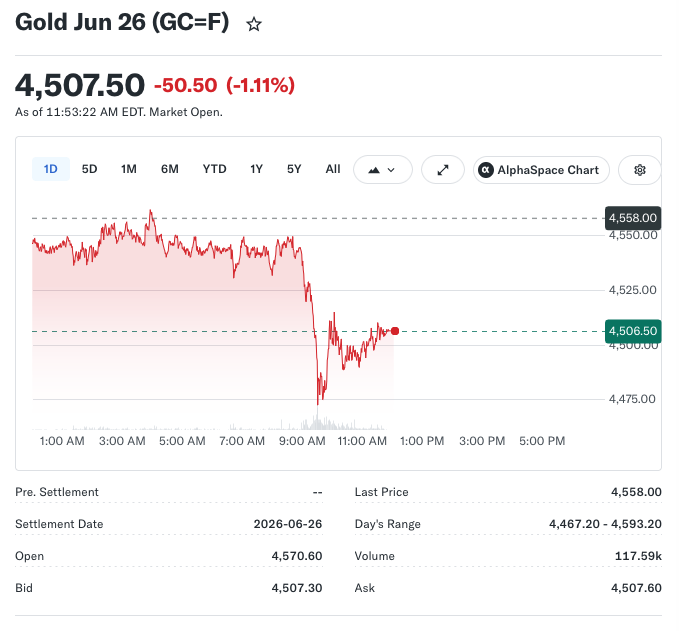
Gold prices slipped beneath a key psychological threshold Tuesday, struggling to maintain footing as investors digested stronger-than-expected data from the U.S. housing market.
The modest uptick in pending home sales has reinforced the view that the economy remains resilient, tempering demand for safe-haven assets like gold.
According to the National Association of Realtors, pending home sales rose 1.4% in April, outpacing economists’ expectations for a 1.0% increase.
Year over year, the data showed a 3.2% rise, suggesting that some buyers are cautiously returning to the market despite elevated borrowing costs.
Here's What They're Not Telling You About Your Retirement
NAR Chief Economist Dr. Lawrence Yun noted that while mortgage rates have inched higher, demand remains surprisingly steady.
“Buyers are coming out with cautious optimism despite increasing economic uncertainty and a slight rise in mortgage rates,” Yun said. He added that demand could strengthen further once rates “retreat to the levels they were at earlier this year.”
The housing data supported a lift in confidence that the broader U.S. economy could avoid sliding into recession. However, that measure of optimism weighed on gold, which often thrives during periods of economic stress or policy uncertainty.
Spot gold traded around $4,495.30 an ounce in late-afternoon trading, down roughly 1% for the session. The move kept the metal below a critical support level of $4,500, raising the risk of additional short-term selling pressure.
This Could Be the Most Important Video Gun Owners Watch All Year
Some analysts believe the combination of firmer housing numbers and elevated inflation fears tied to rising oil prices could continue to challenge gold bulls.
The ongoing war in Iran has driven crude prices higher, heightening inflation expectations and forcing investors to confront the possibility that the Federal Reserve will hold interest rates at restrictive levels for longer than previously anticipated.
Elevated yields typically dampen gold’s appeal, as the metal offers no income and incurs an opportunity cost when compared to interest-bearing assets. The result is a market dynamic where even modest signs of economic strength can drag gold prices down.
The situation highlights how tightly commodity markets remain linked to shifting economic indicators. Positive data from housing or employment reports can lift the dollar and Treasury yields, while simultaneously pressuring metals that thrive on uncertainty or fear of slowdown.
Analysts point out that despite this week’s weakness, long-term fundamentals for gold remain constructive. Persistent inflationary pressures, rising geopolitical risks, and ballooning government debt levels are all conditions that historically support demand for hard assets.
The metal’s impressive rally earlier this year underscores its ongoing role as a hedge against monetary instability and runaway deficit spending.
Still, traders expect gold could remain in a narrow range over the coming weeks. With the Federal Reserve set to maintain its restrictive policy stance until there is clear evidence of cooling inflation, many investors are hesitant to re-enter the gold market aggressively.
Market participants will be watching for upcoming U.S. inflation data and employment figures to gauge whether the Fed’s tightening cycle has reached its peak.
Should evidence of economic weakness emerge later in the summer, sentiment toward gold could quickly reverse, especially if traders begin pricing in rate cuts for 2025.
Until then, gold will have to contend with a backdrop of relative economic strength, bolstered by consumer resilience and a housing market that continues to defy higher rates.
The balance between steady demand for homes and fears of persistent inflation is shaping up as the latest battleground for investors seeking direction in both metal and currency markets.
For now, the $4,500 level remains a critical pivot for gold. If the metal continues to trade below it for a sustained period, technical traders warn the next leg lower could develop swiftly.
A rebound, on the other hand, would signal that investors are once again seeking protection from inflationary and geopolitical turbulence.
In a world marked by uncertainty, gold’s safe-haven appeal is far from lost.
But at least for the moment, optimism in the U.S. housing market—and by extension, confidence in the broader economy—is keeping the precious metal on its heels.
DISCLAIMER: GoldInvestors.news is not a registered investment, legal or tax advisor or broker/dealer. All investment/financial opinions expressed by GoldInvestors.news are from the personal research and experience of the owner of the site and are intended as educational material. Although best efforts are made to ensure that all information is accurate and up to date, occasionally unintended errors and misprints may occur.
Join the Discussion
COMMENTS POLICY: We have no tolerance for messages of violence, racism, vulgarity, obscenity or other such discourteous behavior. Thank you for contributing to a respectful and useful online dialogue.