DISCLAIMER: GoldInvestors.news is not a registered investment, legal or tax advisor or broker/dealer. All investment/financial opinions expressed by GoldInvestors.news are from the personal research and experience of the owner of the site and are intended as educational material. Although best efforts are made to ensure that all information is accurate and up to date, occasionally unintended errors and misprints may occur.
Gold prices have slipped into negative territory for the year, and investors are tightening their grip as bearish sentiment deepens across the market.
According to Standard Chartered’s Global Head of Commodities Research, Suki Cooper, the selloff could worsen as exchange‑traded fund (ETF) holders continue to liquidate losing positions.
Spot gold recently traded around 4,221 dollars an ounce, off nearly one percent on the day and more than two percent since the start of the year.
The metal has now fallen more than five percent since breaching its 200‑day moving average on Friday, a technical breakdown viewed by traders as a signal that further weakness could lie ahead.
Here's What They're Not Telling You About Your Retirement
Cooper warned that gold’s short‑term outlook looks increasingly fragile as macroeconomic forces push investors to reassess their holdings. “We expect price action to become more vulnerable in the near term, driven by macro headwinds. Gold has started taking its cue from real yields again,” she said in her latest report.
The link between real yields and gold is well established. As inflation pressures mount and markets begin pricing in additional rate hikes from the Federal Reserve before year’s end, the yield on inflation‑adjusted Treasuries has risen.
Higher real yields raise the opportunity cost of holding a non‑yielding asset like gold, causing ETF investors to flee for safer or more profitable alternatives.
Cooper noted that even though tactical positioning turned positive in May, ETF flows have been steadily negative. “ETP holdings fell 16 tonnes in May and have continued to decline in June,” she wrote, highlighting a worrying trend of persistent outflows that could further undermine support levels.
This Could Be the Most Important Video Gun Owners Watch All Year
Technical charts now point to key price thresholds that could determine the next move for gold. “An analysis of gold ETP flows shows that at least 270 tonnes of holdings are in loss‑making territory at recent price lows of around 4,250 dollars per ounce,” Cooper stated.
“This rises to 465 tonnes if we assume the net redemptions this year were profitable and established at lower price levels.”
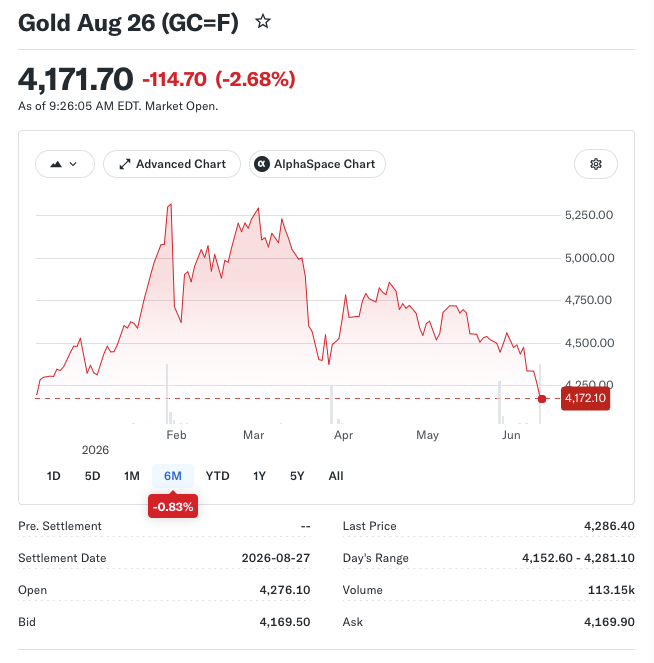
Traders are keeping a close eye on the 4,250‑dollar level, which now serves as the first line of defense.
If the decline deepens, Cooper warned that loss‑making positions could swell to 298 tonnes should prices touch 4,000 dollars an ounce. Such a move could trigger more redemptions and magnify selling pressure in the ETF market.
The renewed strength of the U.S. dollar has also weighed heavily on sentiment. As the greenback recovers alongside Treasury yields, demand for gold—which is priced in dollars—tends to weaken among international investors.
This dual squeeze from both real rates and dollar strength adds to the metal’s challenges in the near term.
Despite these headwinds, Cooper remains cautiously optimistic about the medium‑term outlook. She believes that once the macro picture stabilizes and inflation expectations settle, gold could find a firmer footing.
“ETP holdings are vulnerable in the near term and could expose gold to further downside risk, with the next technical support level around 4,100 dollars per ounce,” she reiterated, suggesting that a rebound could follow once weak hands are shaken out.
The current slide serves as a reminder that even safe‑haven assets are not immune to shifting monetary policy expectations.
Investors rushed into gold earlier in the year anticipating persistent inflation and central bank hesitancy, but the recent hawkish pivot by policymakers has flipped that narrative on its head.
For long‑term holders, the recent correction could eventually offer a buying opportunity, particularly if the Federal Reserve’s tightening cycle proves short‑lived or inflation re‑accelerates.
However, short‑term traders appear to be bracing for more turbulence as ETF investors continue to sell into weakness.
Market participants will be monitoring upcoming U.S. economic data for signs that could either confirm or reverse expectations of a rate hike.
Any indication of slower growth or softer inflation could reduce pressure on yields, potentially offering gold a lifeline.
Until then, the metal’s technical and psychological support levels—4,250, 4,100, and 4,000 dollars per ounce—remain critical battlegrounds. A break below these markers would likely reinforce the bearish narrative and extend the correction that began last week.
While gold has proven resilient over the long haul, its current struggle illustrates how even a small shift in yield expectations can ripple across the broader commodities space.
As investors weigh near‑term losses against the asset’s historic role as a store of value, the gold market’s next move will provide valuable insight into how confidence in hard assets stands amid a still‑uncertain monetary landscape.
DISCLAIMER: GoldInvestors.news is not a registered investment, legal or tax advisor or broker/dealer. All investment/financial opinions expressed by GoldInvestors.news are from the personal research and experience of the owner of the site and are intended as educational material. Although best efforts are made to ensure that all information is accurate and up to date, occasionally unintended errors and misprints may occur.
Join the Discussion
COMMENTS POLICY: We have no tolerance for messages of violence, racism, vulgarity, obscenity or other such discourteous behavior. Thank you for contributing to a respectful and useful online dialogue.