DISCLAIMER: GoldInvestors.news is not a registered investment, legal or tax advisor or broker/dealer. All investment/financial opinions expressed by GoldInvestors.news are from the personal research and experience of the owner of the site and are intended as educational material. Although best efforts are made to ensure that all information is accurate and up to date, occasionally unintended errors and misprints may occur.
Gold prices remain locked in a tight consolidation phase after testing crucial support near $4,000 an ounce, and according to Tanglewood Total Wealth Management’s macro strategist Tom Bruce, this quiet stretch could prove to be the calm before another major advance.
Bruce told Kitco News that he maintains a neutral view in the short term but remains firmly optimistic about gold’s long-term trajectory, noting that the metal’s fundamental strength remains intact despite shifting market sentiment.
He described the current market climate as one of the hardest periods for gold investors to navigate in recent memory, with mixed signals emanating from the Federal Reserve and inconsistent inflation data clouding the near-term outlook.
Earlier this year, gold soared to record highs as central banks around the world poured into the metal, seeking to diversify reserves away from U.S. dollar holdings amid rising geopolitical risk. This surge was also influenced by speculative capital chasing momentum in the commodities space.
Here's What They're Not Telling You About Your Retirement
However, that rally lost traction as excitement shifted back toward technology and AI-driven equities. Investors chasing rapid growth began rotating out of precious metals, leaving gold in a holding pattern, dictated primarily by interest rate expectations.
“The element that was driving gold prices higher earlier this year seems to have moved on,” Bruce explained. “Now gold is being driven by its traditional drivers—interest rates.”
With geopolitical tensions momentarily subdued and safe-haven buying softened, Bruce said that gold’s price movements have grown increasingly sensitive to real interest rate shifts. That linkage, while frustrating for bulls, does not signal breakdown, he insisted, but rather consolidation.
“It’s really consolidation right now,” he said. “We’re in a positioning phase, not a downturn.”
This Could Be the Most Important Video Gun Owners Watch All Year
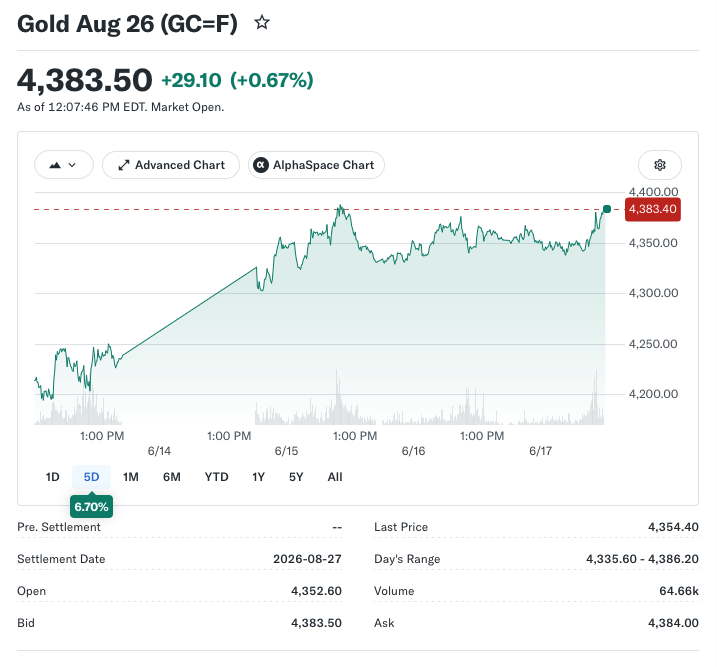
Bruce noted that gold has already absorbed a significant amount of negative sentiment and remains technically strong after repeatedly defending the $4,000 level. He said a meaningful break below that threshold would raise concerns but believes that risk remains contained for now.
“It’s come down a lot already, and it held that $4,000 support level,” he emphasized. “A material break below there would be much more concerning.”
Despite soft investor enthusiasm, Bruce observed that few are exiting gold positions altogether. Long-term holders, including institutional investors and central banks, appear content to maintain their exposure while waiting for renewed momentum driven by either policy shifts or renewed demand from emerging nations.
He also pointed to structural factors that underpin gold’s long-term strength, including the ongoing debasement of fiat currencies, the potential for falling real interest rates, and the likelihood that global central bank buying will reaccelerate after a brief slowdown.
Bruce said the pullback in central bank activity appears more like a pause than an end to accumulation. He argued that any renewed appetite from these state-level buyers could swiftly push prices back toward previous highs. “If central bank buying resumes, that’s probably the quickest path back to record levels,” he said.
Gold’s near-term movements, Bruce added, remain at the mercy of the Federal Reserve. With the Fed kicking off another two-day policy meeting, futures markets are split—roughly half anticipating another rate hike before year-end, while others expect a prolonged pause.
He noted that most of the hawkish narrative may already be baked into current prices, leaving the market primed for an upside surprise if policymakers simply hold steady. “There is very little chance of a cut,” he said. “But if there’s any hint that they will just maintain rates this year—not even cut, but just hold—that would still be positive for gold.”
That view aligns with the broader sentiment among longer-term investors who view gold less as a trading play and more as a strategic store of value in a world drowning in debt and monetary intervention. Even as short-term speculators chase trendy sectors like artificial intelligence or semiconductors, prudent investors continue to regard precious metals as essential insurance against systemic uncertainty.
At the same time, central bank diversification away from the U.S. dollar continues to build a quiet but powerful floor beneath gold. Nations wary of dollar weaponization are seeking hard assets as a safeguard, and that trend shows no signs of reversal.
For Bruce, these underlying forces are what make the present stagnation a buying opportunity rather than a warning. His message to investors is measured but confident: gold may be pausing, but the long game remains heavily tilted in favor of those holding sound money over paper promises.
DISCLAIMER: GoldInvestors.news is not a registered investment, legal or tax advisor or broker/dealer. All investment/financial opinions expressed by GoldInvestors.news are from the personal research and experience of the owner of the site and are intended as educational material. Although best efforts are made to ensure that all information is accurate and up to date, occasionally unintended errors and misprints may occur.
Join the Discussion
COMMENTS POLICY: We have no tolerance for messages of violence, racism, vulgarity, obscenity or other such discourteous behavior. Thank you for contributing to a respectful and useful online dialogue.